
Short answer
There are three ways to get the look. Poured terrazzo is mixed, poured, ground and polished on site by a specialist crew, mostly in commercial buildings. Precast terrazzo tile is made in a factory and installed like natural stone: heavy, on a flat, stiff floor, with full mortar coverage and sealing. Terrazzo-look porcelain is printed porcelain that needs no sealing, which makes it the easy choice for bathrooms and showers.
Terrazzo tile is back in a big way. The speckled look of stone chips set in a smooth base suits modern bathrooms, kitchens and lobbies, and it pairs well with plain tile, wood and solid colours. "Terrazzo" covers three quite different products, though, and they differ in cost, effort, care and where they belong. This guide explains poured terrazzo, precast terrazzo tile and terrazzo-look porcelain, how each is installed, and how to use terrazzo in a bathroom or shower.
What terrazzo is
Terrazzo is a composite. Chips of marble, granite, glass or other aggregate are mixed into a binder, either cement or a resin such as epoxy. Once it has hardened, the surface is ground down to expose the chips in cross-section, then honed or polished smooth. The chips can be tiny or large, close together or widely spaced, in one colour or many. That range is what makes terrazzo so versatile.
It started as a way to use stone offcuts, and it became a classic floor for public buildings because it is hard-wearing and seamless. Schools, airports, hospitals and office lobbies have used it for generations. Today the same look is available as tile and as printed porcelain, which brings it into homes.
Poured terrazzo, terrazzo tile and terrazzo-look porcelain
The three options look similar in a photo. In real life, and in how they are installed, they are very different.
| Poured terrazzo | Precast terrazzo tile | Terrazzo-look porcelain | |
|---|---|---|---|
| What it is | Chips and binder poured in place | Factory-made terrazzo in tile form | Fired porcelain with a printed terrazzo pattern |
| Who installs it | A specialist terrazzo contractor | A tile and stone installer | A tile installer |
| Joints | Divider strips only | Tight grout joints | Grout joints, narrow on rectified tile |
| Sealing | Yes, as the system requires | Usually yes, for cement-based tile | Tile needs none |
| Typical setting | Commercial lobbies, schools, large floors | Bathrooms, kitchens, smaller commercial floors | Bathrooms, showers, kitchens, homes and businesses |
Each one has a place. Poured terrazzo is the real, seamless thing, built into the building. Precast terrazzo tile gives genuine terrazzo in a format that a tile installer can set. Terrazzo-look porcelain gives the look with porcelain's low maintenance and wide choice of sizes. Our guide on how to choose tile covers the questions that apply to any of them.
Poured terrazzo floors: what's involved
A poured terrazzo floor is built on site in stages. Divider strips, usually metal or plastic, are set into the floor to control cracking and to separate colours or patterns. The terrazzo mix is placed between them, levelled and left to cure. The whole surface is then ground down in several passes with heavy machines, filled, ground again, polished and sealed.
There are two broad families. Cement-based terrazzo is the traditional kind. It is heavy, and some systems are thick, so the floor structure and the floor height have to be planned for it. Epoxy terrazzo is a thinner, lighter resin system with a very wide range of colours. It is common in modern commercial buildings and needs a sound, prepared concrete slab.
Either way, poured terrazzo is specialist work. It involves wet grinding, slurry, noise and several days of curing and finishing, so it is usually done in new buildings or large renovations rather than in an occupied home. Agora doesn't pour terrazzo; that is a job for a terrazzo contractor. We install terrazzo tile and terrazzo-look porcelain, including on commercial flooring projects.
Installing precast terrazzo tile
Precast terrazzo tile is cast, cured, ground and finished in a factory, then cut into tiles. Most are cement-based, with marble or other stone chips; some are resin-based. They come honed or polished, often in squares, and they are dense and heavy. Treat them as natural stone, because the installation demands are much the same.
A stiff, flat floor. Terrazzo tile is rigid and heavy, and much of it is marble chips. It needs a floor that doesn't flex. Industry guidance limits deflection over wood framing to L/360 for ceramic and porcelain and L/720 for natural stone. Because terrazzo tile is largely stone, aiming for the stone standard is the safer plan, and the tile maker's instructions decide. The floor must also be flat, because a heavy tile won't follow a dip; it bridges it and leaves a hollow. Our guide to the right subfloor for tile explains how floors are checked and corrected.
Full coverage. The tile is set in a polymer-modified mortar the tile maker approves, often white under light colours, so grey mortar doesn't shadow through. Larger tiles need a large-and-heavy-tile mortar. Each tile is back-buttered and pressed into combed mortar. Industry standards call for at least 80% contact in dry areas and 95% in wet areas, and heavy tile with voids under it cracks under point loads. Our guide on which thin-set to use explains the ratings.
Flat joints. Precast terrazzo tile is usually made to tight size tolerances, so it is set with narrow joints and the surfaces have to meet flush. Lippage shows clearly on a honed or polished terrazzo floor. Levelling clips help keep edges flush as the mortar cures; see lippage and levelling systems. Some terrazzo tile floors are ground and polished after installation to make the joints disappear, which is specialist work.
Cut it on a wet saw with a blade for stone. The dust is fine and can contain silica, so cut wet and wear a respirator, eye and hearing protection.
Sealing and grouting terrazzo tile
Cement-based terrazzo tile is porous, both in the binder and in many of the stone chips. Grout pigment can stain it, so it is usually sealed before grouting with the sealer the tile maker recommends, and again once the grout has cured. Resin-based terrazzo tile is much less porous, but its maker may still have a sealing or cleaning step. Follow the instructions for the product you buy.
Joints are narrow, so unsanded or a fine high-performance grout is usual. Sand can scratch a polished face during grouting. Our guide to grout types explains the choices. Clean grout off gently with a damp sponge, and never use acid-based haze removers: marble chips etch, and so does a cement binder. After the final seal, reseal as the maker suggests; our guide on sealing grout covers the wait time and the water test.
Terrazzo in bathrooms and showers
A terrazzo bathroom floor looks fresh and clean, and both precast terrazzo tile and terrazzo-look porcelain work there. Real terrazzo tile needs the same care as marble: sealing, pH-neutral cleaners and quick wiping of anything acidic. Polished terrazzo is slippery when wet, so honed is the better finish on a bathroom floor.
In a terrazzo shower, terrazzo-look porcelain is usually the practical choice. It absorbs almost no water, needs no sealing and isn't harmed by shampoo or soap the way marble chips and cement can be. Like all tile, it relies on a waterproofing membrane behind it; see how to waterproof a shower. Our guide to choosing shower tile covers how materials suit walls and floors.
Many terrazzo-look porcelains come in large formats, such as 24 × 48. Big tiles mean fewer grout lines on shower walls, but they need flat walls, the right mortar and full coverage. Our large-format tile guide explains what that involves. On a shower floor, large tile needs a single-direction slope, usually to a linear drain. With a centre drain, a small mosaic floor in a matching colour follows the slope more easily. Choose a matte finish with a slip rating suited to wet floors; a DCOF of 0.42 or higher is common guidance for level interior floors that get wet, and the tile maker should list the tile as suitable for shower floors.
Pairing terrazzo with other tile, and choosing grout colour
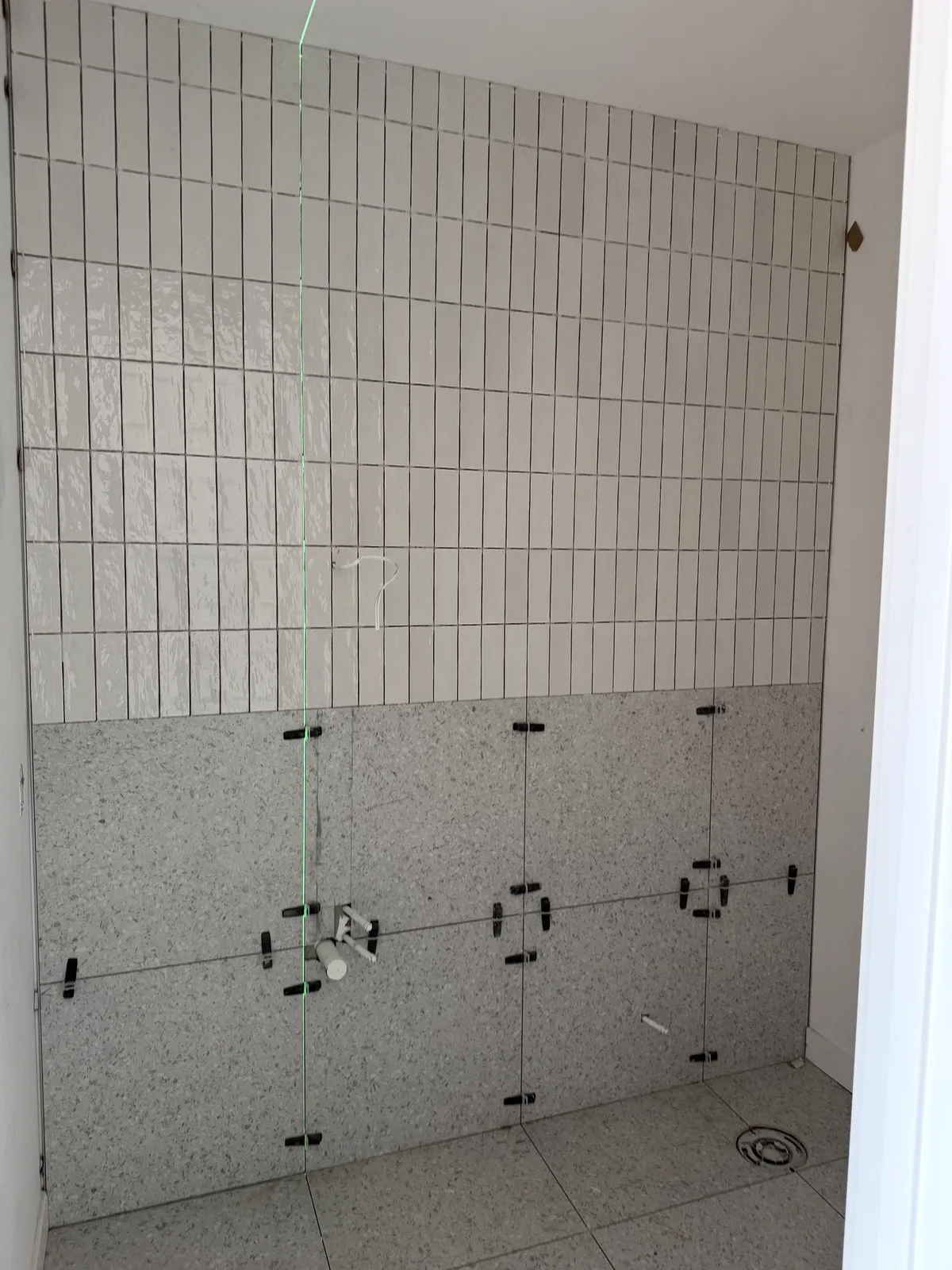
Terrazzo has a lot going on, so it usually pairs best with something calm. The shower above shows a common approach: terrazzo-look large-format tile on the lower part of the wall, and plain white tile stacked above it. The busy pattern sits where splashes land, and the plain tile above keeps the room light.
A two-tone wall needs planning. The line between the two tiles should land at a sensible height, often lined up with a niche, a bench, the valve or the top of a vanity. It should be level all the way around the room, even if the floor or tub isn't. If the two tiles differ in thickness, the joint between them is finished with a slim metal profile or set so the faces line up. Our guide to tile edge trim shows the profiles used at changes of tile.
For grout, pick out the background colour of the terrazzo, not the chips, so the joints fade and the floor or wall reads as one surface. With a two-tone wall, many people use one grout that suits both tiles, or a slightly different shade on each that meets at the change line. On floors, a mid-tone grout hides dirt better than white. Pull a colour from the chips into another finish in the room, such as a vanity, a paint colour or a fixture, to tie it together.
Caring for terrazzo floors and tile
Real terrazzo, poured or precast, is cared for like natural stone. Sweep or vacuum grit, which scratches a polished surface. Damp-mop with a pH-neutral cleaner. Avoid vinegar, lemon, bleach, abrasive powders and acidic bathroom cleaners, which etch marble chips and dull a cement binder. Reseal when water stops beading. Our guide to natural stone care covers the water test, etching and stains.
A well-kept terrazzo floor lasts a very long time, and worn or etched terrazzo can usually be reground and polished by a terrazzo or stone restoration specialist. Terrazzo-look porcelain needs only ordinary tile care: a pH-neutral cleaner and attention to the grout.
What drives the effort and cost
The three options sit at very different levels of effort. Poured terrazzo is the most involved: a specialist crew, divider strips, curing, multiple grinding passes and sealing, all on site, usually across a large floor. Precast terrazzo tile is a stone installation: a flat, stiff floor, heavy tile, back-buttering, sealing before and after grouting, and careful work to keep the joints flush. Terrazzo-look porcelain installs like any other porcelain of the same size, though large formats need the flatness and care described above.
For a tiled bathroom or kitchen, the factors that move the price are the tile itself, its size, the floor preparation, any shower waterproofing and the amount of cutting. Our guide to tile installation cost in Ottawa explains them. For a terrazzo bathroom or shower, our bathroom and shower tile page covers what we install.
Frequently asked questions
Is terrazzo tile real terrazzo?
Precast terrazzo tile is: it is real chips in a binder, made in a factory and cut into tiles. Terrazzo-look porcelain is not; it is porcelain printed to look like terrazzo.
Can terrazzo tile be used in a shower?
Terrazzo-look porcelain is well suited to showers, with a waterproofing membrane behind it. Real terrazzo tile can be used, but it needs sealing and stone-safe products, because soaps and cleaners can etch it.
Is terrazzo slippery?
Polished terrazzo is slippery when wet. A honed finish, or a matte terrazzo-look porcelain with a suitable slip rating, is better for bathrooms and entries.
Does terrazzo need to be sealed?
Cement-based terrazzo, poured or precast, is sealed and resealed over time. Resin terrazzo follows its maker's instructions. Terrazzo-look porcelain needs no sealing, only the grout if it is standard cement grout.
What grout colour goes with terrazzo tile?
Usually the background colour of the terrazzo, so the joints fade away. A mid-tone grout hides dirt best on floors.
Can terrazzo tile go over a wood subfloor?
Yes, if the floor is stiff and flat enough for heavy, stone-like tile, usually with a membrane or second subfloor layer the system allows. Check the tile maker's requirements first.