Short answer
The best thinset for porcelain tile is usually a polymer-modified mortar rated ANSI A118.4 or the higher A118.15, and a large-and-heavy-tile (LHT) mortar once any side of the tile reaches about 15". Over a membrane or heating system, use a mortar that maker lists. Glass and light marble go in white mortar made for them, and premixed adhesives belong only where their pail allows, never on porcelain floors or in showers unless the product says so.
Walk into any tile supplier and you will find a wall of grey and white bags with similar names. Picking the right one is simpler than it looks. You need to know three things: what tile you are setting, what you are setting it on, and where it is going. This guide works through the common situations one by one, so you can match the job to the right line on the bag.
Modified vs unmodified, in one paragraph
Thin-set is a cement-based mortar that bonds tile to the surface beneath it. Unmodified (dry-set) thin-set cures by reacting with water alone. Modified thin-set has polymers added for stronger bond and some flexibility, and those polymers also need to dry to reach full strength. Most porcelain jobs use modified mortar, and some membrane makers have specified unmodified or their own mortars for tile set over their membranes. We explain the difference in depth, including two-part systems and shelf life, in modified vs unmodified thin-set.
How to read a mortar bag
Most bags sold in Canada carry North American ANSI ratings, and many also carry European ISO 13007 classes. These tell you what the mortar has been tested to do. They are more useful than the marketing names on the front.
| Rating on the bag | What it means in general |
|---|---|
| ANSI A118.1 | Unmodified (dry-set) cement mortar |
| ANSI A118.4 | Modified (latex-portland cement) mortar |
| ANSI A118.11 | Modified mortar tested for bonding to exterior-glue plywood |
| ANSI A118.15 | "Improved" modified mortar, with higher performance than A118.4 |
| LHT (large and heavy tile) | Holds a thicker bed under large or heavy tile without slumping |
| ISO C1 / C2 | Cement-based adhesive, normal (C1) or improved (C2) |
| ISO F, T, E | F = fast-setting; T = reduced slip, for walls; E = extended open time |
| ISO S1 / S2 | Deformable (S1) or highly deformable (S2): more flexible |
| ISO D and R | D = dispersion (premixed) adhesive; R = reaction resin, such as epoxy |
Some bags add letters after the ANSI number for features such as fast setting, extended open time or non-sag. The bag or data sheet explains them. Read the back of the bag too. It lists the tile types, sizes, surfaces and areas the mortar is approved for, its minimum temperature, its pot life and open time, and the trowel or coverage the maker expects.
Which thinset to use: a decision table
Use this table as a starting point. The tile maker's and the membrane or board maker's instructions come first, and on commercial work the project specification names the mortar.
| If you're tiling… | Look for on the bag |
|---|---|
| Porcelain floor tile on concrete or cement board | Modified, A118.4 or A118.15 (ISO C2) |
| Tile with any side about 15" or longer | LHT mortar, usually A118.15; back-butter |
| Large tile on walls | Non-sag LHT mortar, often lightweight (ISO T) |
| Over an uncoupling or waterproofing membrane | A mortar the membrane maker lists for that membrane, tile and area |
| Bonding a membrane or tile to plywood | A118.11, or what the membrane maker specifies |
| Glass or translucent tile | White mortar the glass tile maker approves |
| Marble and light natural stone | White modified mortar; LHT for large stone |
| Moisture-sensitive stone (some green marbles) | The special setting material the stone supplier specifies |
| Over an electric heating system | A mortar the heating system's maker lists |
| Fast turnaround or a cool job site | Rapid-setting mortar (ISO F) |
| Shower floor slope or a big build-up | A mortar bed (floor mud), then thin-set on top |
| Small wall tile in a dry area | Thin-set, or a premixed adhesive if the pail allows that tile and area |
Best thinset for porcelain tile floors
Porcelain is dense and absorbs almost no water, so the mortar can't soak into the back of the tile the way it does with softer ceramic. It has to bond by adhesion, which is what polymer-modified mortars are made for. For a porcelain floor on concrete, cement board or a properly prepared surface, look for a modified mortar rated ANSI A118.4 or, better, A118.15. On the ISO scale, that is a C2 mortar.
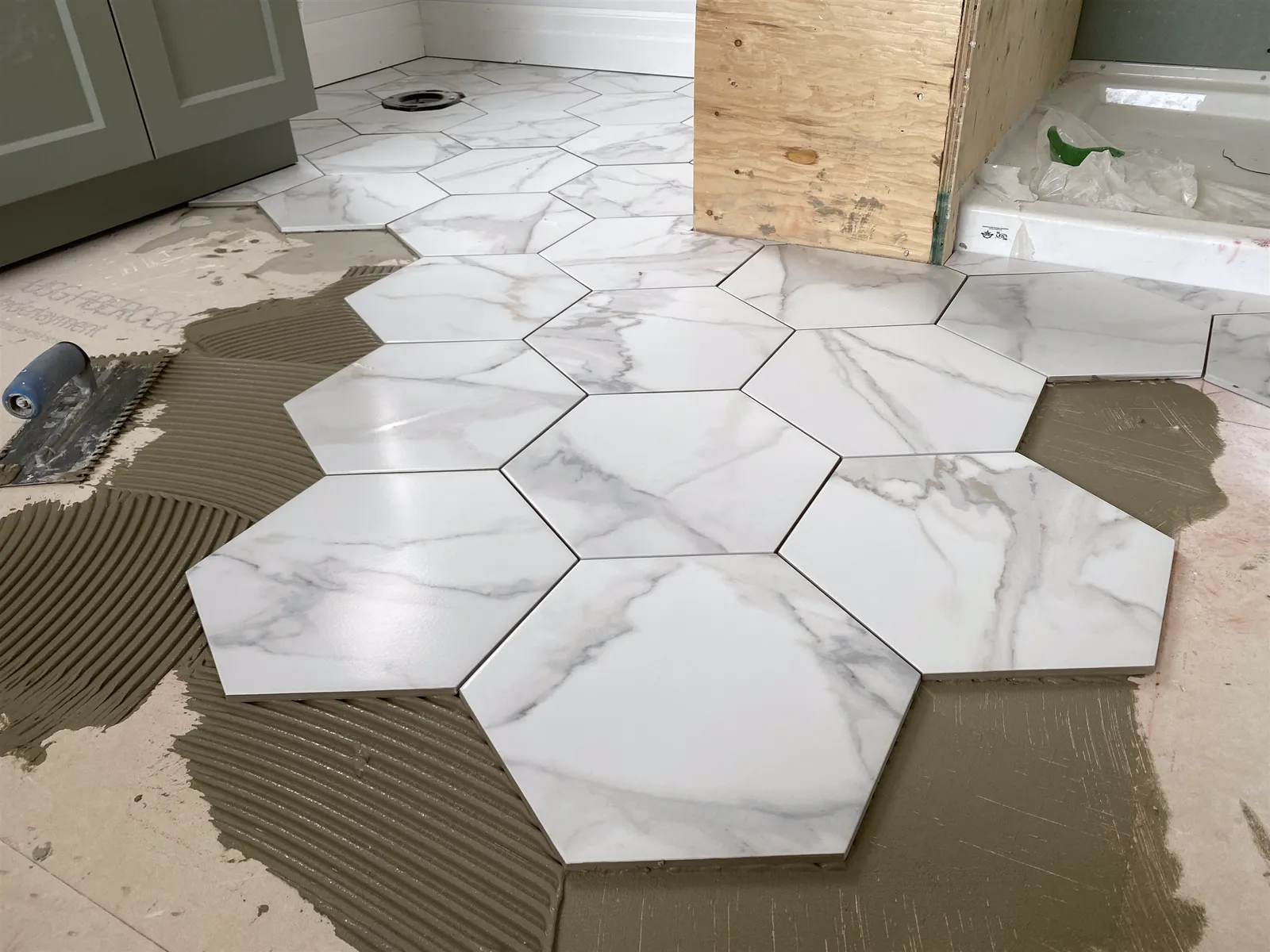
Floor mortars are made to flow, so the ridges collapse fully when the tile is pressed in. That is how you reach the coverage standards ask for: at least 80% contact in dry interior areas and 95% in wet areas, with edges and corners supported. The right trowel gets you most of the way, as shown in what size trowel for tile. The other part is technique: keying the mortar in, combing straight ridges and checking by lifting a tile.
Ordinary ceramic floor tile is more forgiving and can often go in a standard mortar, but most installers use the same modified mortar for both. The price difference is small compared with the cost of loose tiles.
Large tile, and the best thinset for porcelain tile on walls
Large-format tile, with any side about 15" or longer, needs a large-and-heavy-tile (LHT) mortar. These mortars are built to hold a thicker bed under a large tile without slumping as they cure. Ordinary thin-set spread that thick can shrink and leave hollows. LHT mortars are often rated A118.15, and many are lightweight, which makes them easier to spread and kinder to walls. Our large-format tile guide explains why these tiles need it.
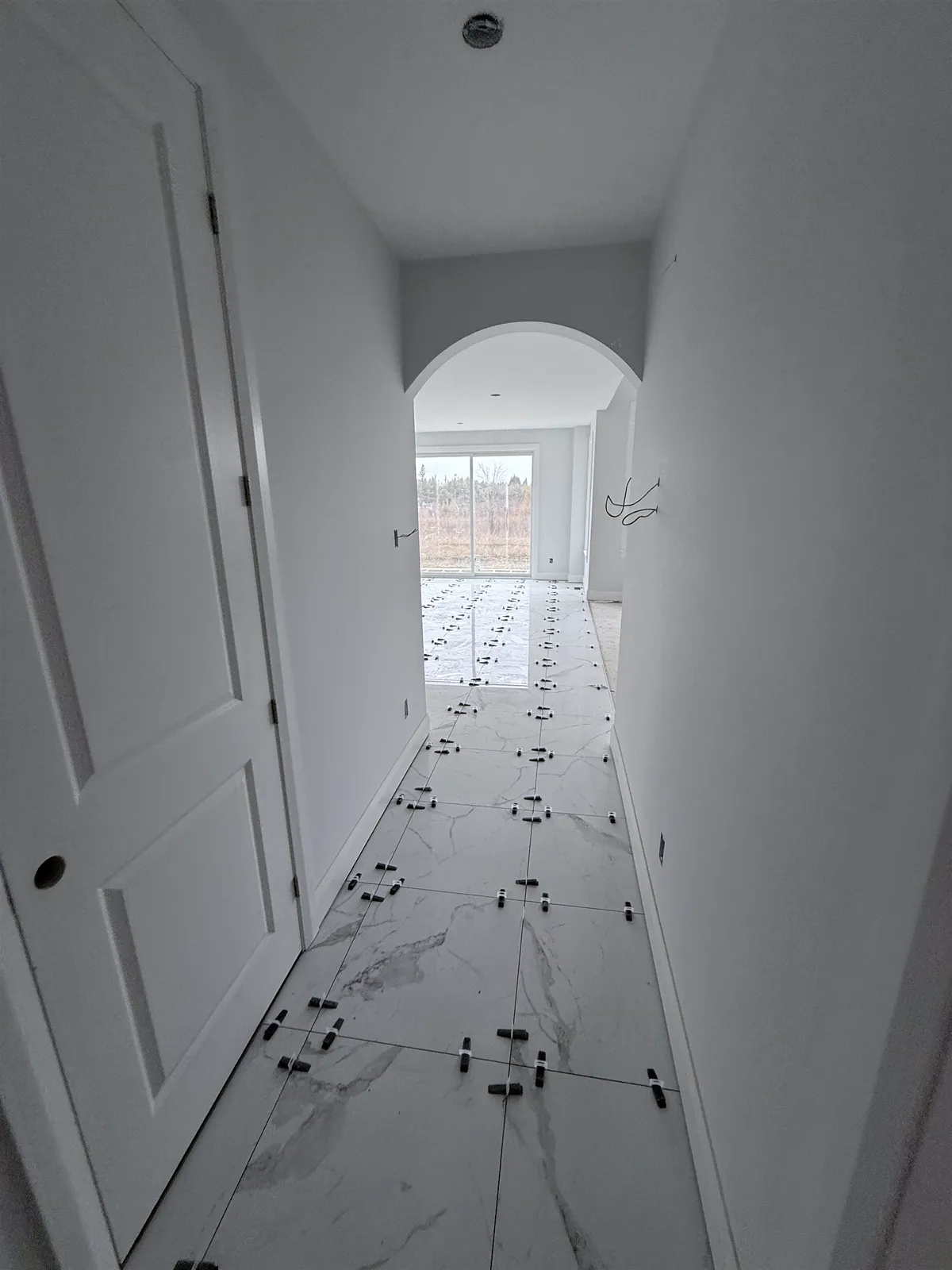
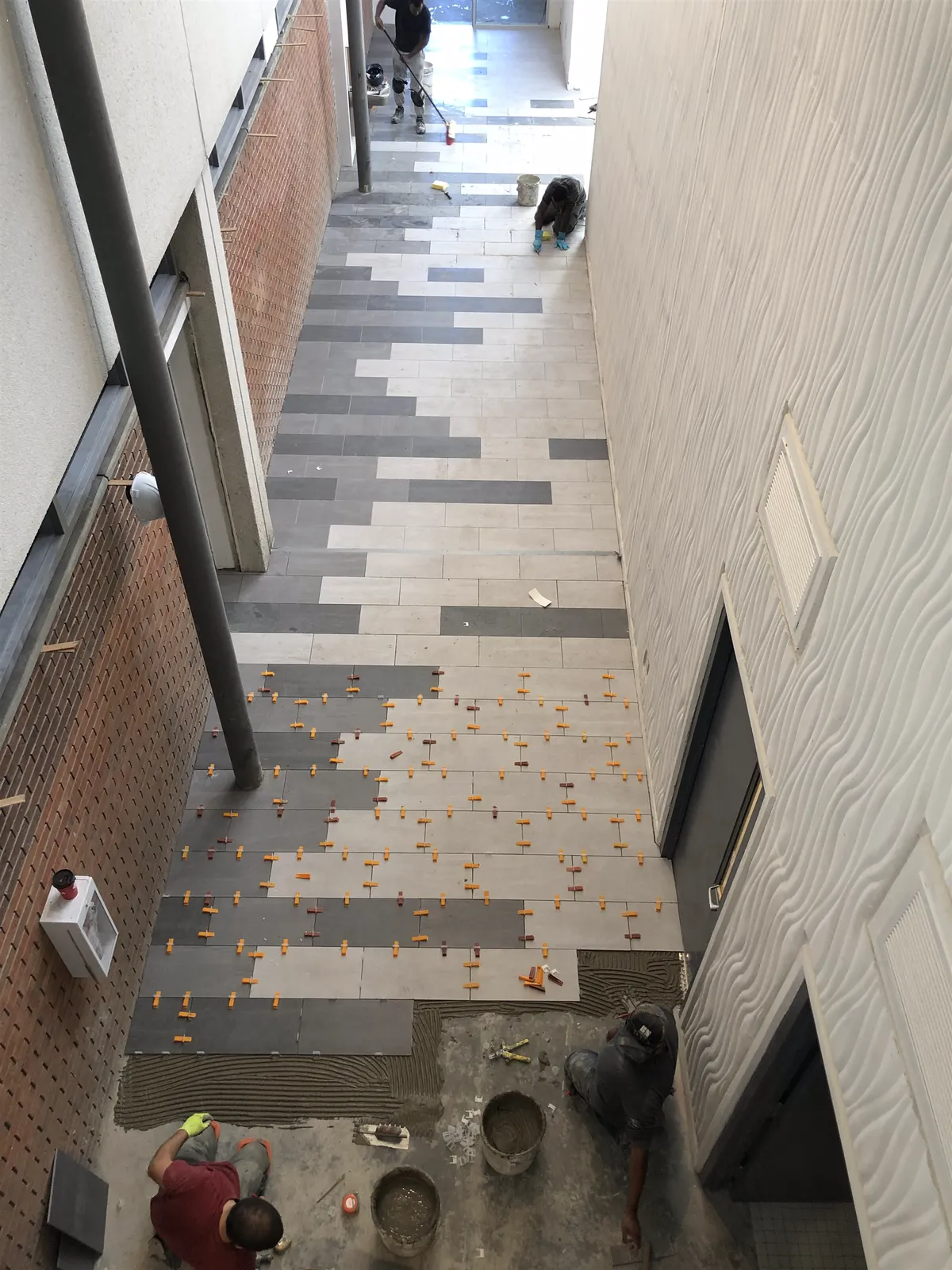
Large tile also needs back-buttering: a thin, flat coat of mortar on the back of each tile before it goes into the ridges on the floor or wall. It fills the tile's back pattern and helps reach full coverage. Large tile is almost always set with a levelling system as well, as in the corridor shown above, and the floor has to be flat before any of this works.
For porcelain tile on walls, choose a non-sag mortar, marked T on the ISO scale. It grabs the tile and holds it in place while it cures, so the tile doesn't slide down the wall. Lightweight non-sag LHT mortars are the usual choice for 12 × 24 and larger shower walls. Our guide on how to tile a shower covers the rest of the wall process.
Over uncoupling and waterproofing membranes
This is the situation where the rule is simplest: use a mortar the membrane maker lists. Membranes such as Schluter-DITRA and KERDI, and the many liquid waterproofing membranes, are tested with particular mortars, and the system warranty usually depends on following that list. The mortar used to bond the membrane to the floor can be different from the mortar used to set tile on top of it.
The reason is curing. A sheet membrane and porcelain tile are both waterproof, so the mortar between them can't dry out the way it would on a porous surface. Some modified mortars stay soft for a long time in that sandwich. Makers deal with this in different ways, and their requirements have changed over the years. For Schluter membranes, check Schluter's current installation handbook for its mortar requirements. Schluter also makes its own mortars, such as SET, ALL-SET and FAST-SET. For liquid membranes, the liquid's maker lists approved mortars, often its own. See what Schluter-DITRA is and how to waterproof a shower.
Glass, translucent tile, marble and light stone
Glass tile shows what is behind it. Grey mortar can make it look dull or patchy, and trowel ridges can show through clear glass as lines. Glass also doesn't absorb anything, and it expands and contracts differently from ceramic. That is why glass tile makers usually ask for a white mortar formulated or approved for glass. Many also ask for the ridges to be flattened, or the tile back-buttered, so the bed looks even through the glass. Follow the glass tile maker's instructions closely, because some products are very specific.
Marble and other light natural stone go in white mortar. Grey mortar can show through light, translucent stone, or leave a shadow around the edges where the stone absorbs moisture from the mortar. Light grout joints next to grey mortar can also look darker. Large stone needs an LHT mortar and back-buttering, like large porcelain.
Some stones are moisture-sensitive. Certain green marbles and some other stones can warp, curl or stain when set in an ordinary water-based mortar. They need special setting materials, such as an epoxy or a very rapid-setting mortar that ties up the water quickly, as the stone supplier specifies. Ask about it before you buy the stone, not on installation day. Our guide to natural stone care covers sealing and upkeep afterwards.
Heated floors
Electric floor heating changes the mortar choice in two ways. First, the mortar has to fully encase the cable or fill the membrane that holds it, without voids. Second, the floor will heat and cool every day for decades, so the mortar must be one the heating system's maker has tested with its product. Use the mortars on that maker's list, for both the membrane and the tile.
Don't turn the heat on to speed up curing. The system stays off until the mortar and grout have fully cured, as the maker states. Our DITRA-HEAT guide explains the steps, and our heated floor installation page covers what we install. A licensed electrician makes the final connection.
Rapid-setting mortars
Rapid-setting mortars cure in hours instead of a day. Grout can often go in the same day, and the floor goes back into use sooner. They are useful for repairs and for spaces that can't close for long, such as stores and commercial kitchens. They also help on cool job sites, where an ordinary mortar would cure very slowly.
The trade-off is a short pot life, the time the mixed mortar stays usable in the bucket, and a short open time on the floor. Mix small batches, spread only what you can tile right away, and never add water to a batch that has started to stiffen. Rapid-set mortars are less forgiving for a first-time installer, because there is little time to adjust tiles.
Mortar beds for shower floors and levelling
Thin-set is a thin bonding layer, not a way to build up or slope a floor. When a shower floor needs a slope to the drain, or a floor needs a thick build-up, a mortar bed is used instead. It is a stiff mix of sand and portland cement, often sold pre-bagged as floor or deck mud. It is packed and screeded to shape, left to cure, and then the tile is set on it with thin-set.
In a shower, the bed is part of the waterproofing design: either under a bonded membrane, or over a traditional liner, depending on the system. A pre-sloped foam tray is another option. Our comparison of a shower pan vs a tiled shower floor explains the choices. For flattening a floor before tile, a self-levelling compound or patch is the usual tool, not extra thin-set.
Tile adhesive vs thinset, and premixed mastic
"Tile adhesive" means different things in different places. In Europe and the UK it usually means a cement-based adhesive, the same family as North American thin-set, rated with ISO classes such as C1 and C2. In North America, "adhesive" or "mastic" usually means a ready-mixed organic product sold in a pail, made to the ANSI A136.1 standard. It sets by drying, not by cement curing.
Premixed adhesives are handy for small, light wall tile in dry areas, such as many kitchen backsplashes. They are not for porcelain floors, large or heavy tile, outdoor work or showers, unless the product clearly says it is approved for that use. Under large or dense tile they dry very slowly, and in wet areas water can soften them over time. Some newer premixed products are rated for floors or larger tile; use them only within the tile sizes and areas printed on the pail. When in doubt, use thin-set. Our guide on how to install a backsplash covers where mastic does and doesn't fit.
Grey vs white thin-set
Grey and white versions of the same mortar usually perform the same; the difference is the colour of the cement. Grey is standard for most floor tile and dark tile, and it often costs a little less. White is used for glass, translucent tile, marble and light stone, and under light-coloured grout where grey could show through a thin joint or darken the grout. Some installers use white on light wall tile too, so any mortar that squeezes into the joints doesn't shade the grout.
Mixing, coverage and cold job sites
The best mortar fails if it is mixed or spread badly. Measure the water exactly as the bag says, mix with a slow drill and paddle, let it slake (rest) for the time listed, then remix. Don't add water once it stiffens. Spread only what you can tile within the open time, because a skin on the surface means the tile won't bond. Lift a tile now and then to check coverage.
Temperature matters a lot on Ottawa job sites. Cold slows curing, so grouting and traffic wait longer, and fresh mortar must never freeze. Many bags list a minimum installation temperature of around 10°C (50°F) for the air and the surface, and ask for that temperature to be held for some time after installation. A basement slab in winter or an unheated new build can be well below that. The space may need heat before, during and after the job. Hot, dry rooms have the opposite problem: mortar skins over quickly, so smaller areas are spread at a time.
Makers such as MAPEI, Laticrete and Custom Building Products each offer several of these types, from standard modified mortars to LHT, non-sag and rapid-setting ones. Schluter makes mortars for use with its own membranes. Choose by the rating and the approvals on the bag, not by the brand alone. If you are hiring, a good tile installer should be able to tell you which mortar they plan to use and why.
Frequently asked questions
What is the best thinset for porcelain tile?
For most porcelain floors and walls, a polymer-modified mortar rated ANSI A118.4 or A118.15. Use an LHT mortar for tile with any side about 15" or longer, and the membrane maker's listed mortar when tiling over a membrane.
What thinset should I use for 12 × 24 tile?
A large-and-heavy-tile (LHT) mortar, usually rated A118.15, with back-buttering and a large-notch trowel. On walls, choose a non-sag lightweight LHT mortar.
Can I use mastic instead of thinset?
Only for the tile types and dry areas the pail allows, typically small, light wall tile such as many backsplashes. Not for porcelain floors, large tile, outdoors or showers unless the product clearly says so.
Do I need white thinset for white tile?
Not for ordinary opaque porcelain or ceramic. White mortar matters for glass, translucent tile, marble and light stone, and it helps under very light grout.
What thinset goes over Schluter DITRA or KERDI?
One of the mortars Schluter lists in its current installation handbook for that membrane and tile. Schluter makes its own, including SET, ALL-SET and FAST-SET; check the handbook rather than an old job or forum post.
Can thinset be used in cold weather?
Only within the temperature range on the bag, for both the air and the surface, during installation and curing. Cold slows curing and fresh mortar must never freeze, so cold sites are heated first.