
Short answer
For most Ottawa homes, the best entryway tile is porcelain with a matte or textured finish, in a mid-tone or variegated colour that hides salt and grit, with a mid-tone grout that is sealed or stain-resistant. Slate is a tough natural option that needs sealing. Plan the door threshold, the transition to the hall floor and the subfloor near the door before any tile goes down.
The front entry and the mudroom take more punishment than any other floor in an Ottawa house. From November to April they get road salt, sand, grit, melting slush and wet boots every day. Entryway tile is the most common answer, and for good reason. This guide covers which tile works best at the door, how to choose a finish and colour that cope with winter, and the installation details that decide whether an entry floor lasts: the threshold, the transitions, the subfloor near the door and heated floors.
Why entries are so hard on floors
Winter brings three problems in through the door. The first is water. Snow melts off boots and sits on the floor, sometimes for hours. The second is grit. Sand and small stones from sidewalks and driveways get ground underfoot, and grit acts like sandpaper on any surface. The third is salt. Road salt and calcium chloride dissolve in the slush, then dry into a white film on the floor and in the grout.
On top of that, the area right inside an exterior door is often the coldest part of the floor. Cold air rolls in each time the door opens, and the floor structure near the door is often less insulated than the rest of the house. A good entry floor shrugs off water, resists scratching, hides a little dirt between cleanings, and stays safe underfoot when it is wet.
Entryway tile options: porcelain, slate or vinyl plank
Three floors are common at Ottawa doors. Each has a place.
| Floor | Strengths | Weak points |
|---|---|---|
| Porcelain tile | Hard, absorbs almost no water, no sealing, huge choice of looks | Hard and cold underfoot without heat; grout needs care |
| Slate | Very tough, natural texture for grip, hides dirt well | Needs sealing; uneven pieces; some slates flake |
| Rigid-core vinyl plank | Warmer, quieter, can match wood floors beyond the entry | Grit scratches the wear layer; water can get under seams |
Porcelain is the easiest choice for most entries. It is dense and hard, so grit and salt don't hurt it, and it needs no sealing. Colour-body or through-body porcelain hides chips better than a glazed tile with a different-coloured body underneath. Slate-look, stone-look and concrete-look porcelain all suit an entry. Our guide to porcelain vs ceramic tile explains why porcelain, not softer ceramic, belongs on a busy floor.
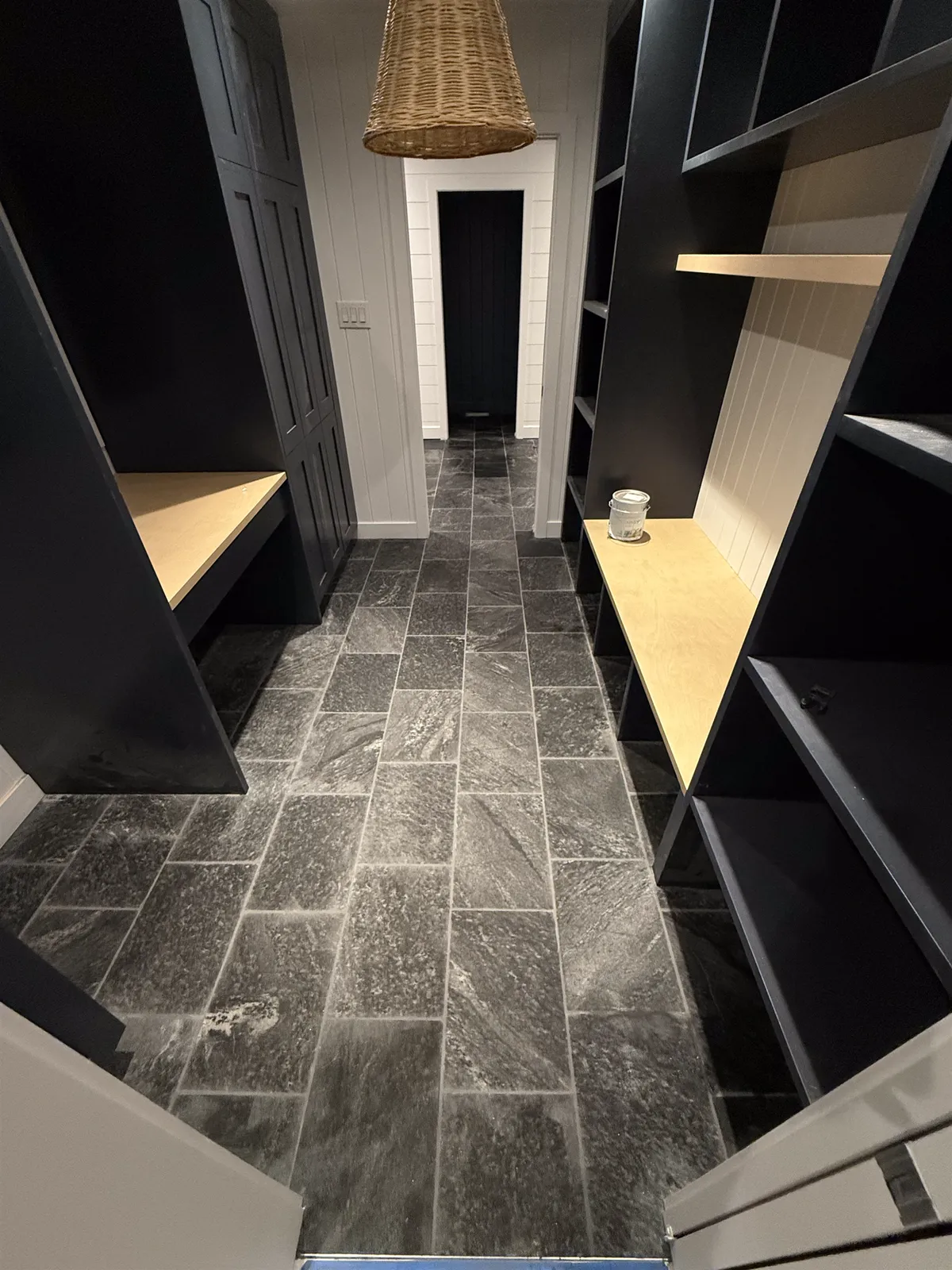
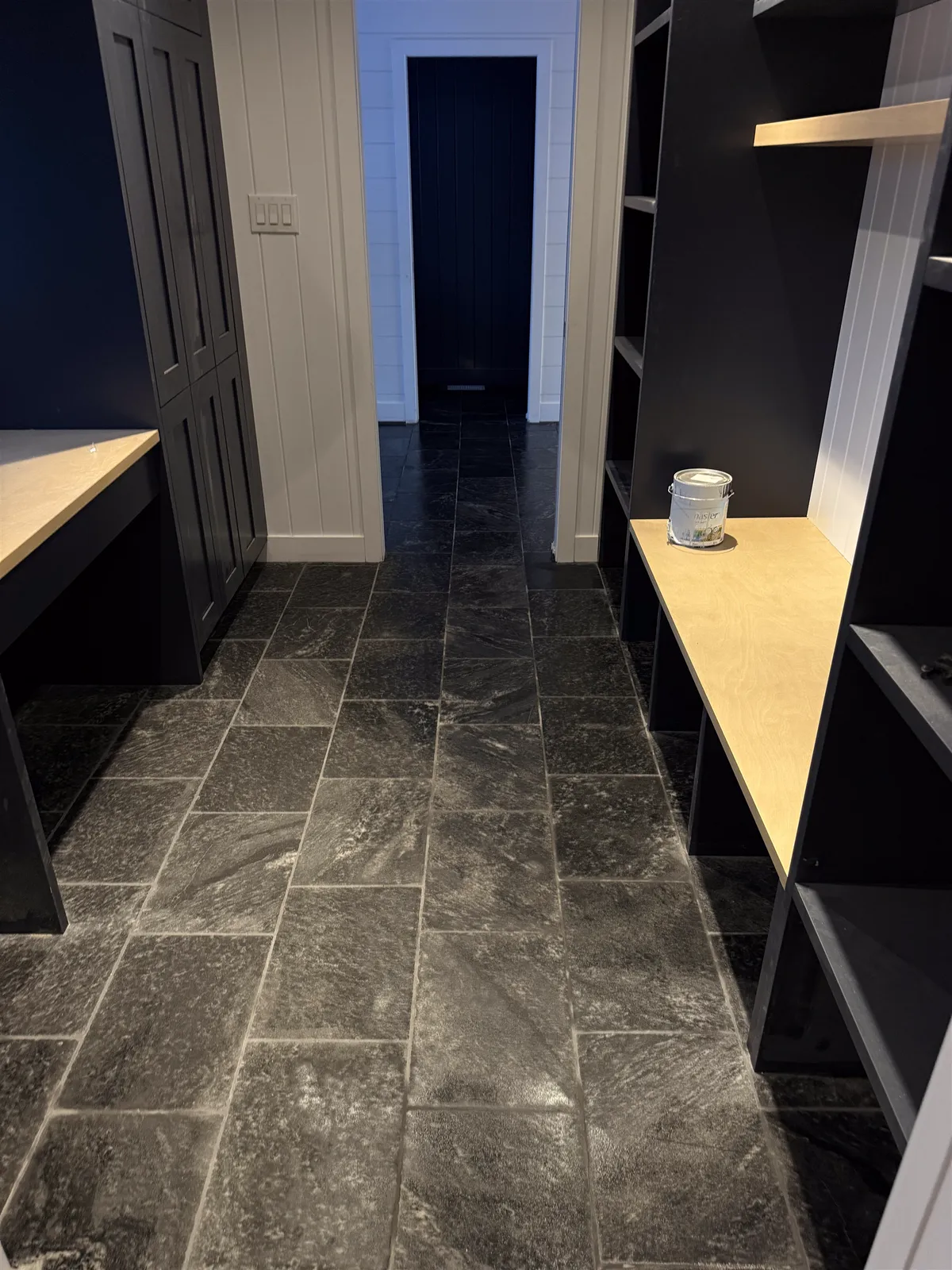
Slate is a natural stone that has been used at doors for generations, and a slate entry floor like the mudroom above suits a busy household. Its split, or cleft, surface gives grip, and its colour variation hides dirt. It is porous, so it is sealed after installation and resealed over time. Pieces vary in thickness unless the slate is gauged, so setting it flat takes more time. Some softer slates can flake at the surface, so buy from a supplier who will tell you how that stone behaves on a floor.
Rigid-core luxury vinyl plank is a fair option where the entry opens into a room with the same vinyl, so the floor runs through without a transition. It is warmer and quieter than tile. The trade-off is that sand and grit scratch its wear layer over time, and water from melting snow can get into the seams if it sits. Our guide to tile vs luxury vinyl compares the two in detail, and we install both, including vinyl plank floors.
Grip: finishes that stay safe when wet
An entry floor is wet much of the winter, so slip resistance matters as much as looks. Tile makers publish a wet slip rating called DCOF. A value of 0.42 or higher is the common guidance for level interior floors that get wet. Look for it on the spec sheet, not just in the showroom.
Matte, textured and structured finishes give the most grip. Polished and high-gloss tile looks striking in a showroom but turns slick under a film of meltwater. Smaller tiles add grout lines, which also help underfoot. A slight texture also hides scuffs and salt marks better than a smooth, shiny face. The one trade-off is cleaning: deeply textured tile holds dirt in its surface, so a lightly textured or matte finish is often the best balance for a front entry.
Entryway tile colours that hide salt and dirt
Colour decides how often the floor looks dirty. Solid black and very dark tile show every white salt mark. Bright white shows sand, mud and grey slush. Mid-tone greys, warm taupes and browns hide both, and variegated tile, with natural-looking shifts in colour, hides them best. That is part of why slate and slate-look porcelain are so popular at Ottawa doors.
Patterned floors work at entries too. A patterned tile breaks up the surface, so a bit of grit between cleanings disappears into the design. Encaustic-look porcelain gives the look of old cement tile without the sealing; our guide to cement tile compares the real thing with porcelain versions. Hexagons, a checkerboard or a simple border around the door mat area are other options. Our guide to hexagon tile covers that shape.
Size matters less than finish and colour, but it affects the layout. Entries are often small and broken up by closets and door openings, so very large tiles can mean awkward cuts. A 12 × 24 tile or similar suits most entries. The layout should put a full tile, or a generous cut, at the door, where everyone sees it first.
Grout and sealing at the door
Grout is the weak point of most entry floors. Standard cement grout is porous, so salty water and dirt soak in and darken it, especially along the main walking path. A mid-tone grout close to the tile colour hides the most. Avoid white grout at a door.
A high-performance cement grout, or epoxy grout, resists stains much better than basic grout. Standard cement grout should be sealed once it has cured and resealed when water stops beading. Our guides to grout types and to sealing grout explain the choice. Natural slate gets its own stone sealer as well, so winter salt wipes off the surface instead of soaking in.
Joint width follows the tile. Rectified porcelain can take narrow joints, which means less grout to keep clean. Slate and other uneven stone need wider joints to absorb the variation in size and thickness.
Mats, boot trays and mudroom layout
The best protection for any entry floor is to stop the grit before it reaches the tile. A coarse scraper mat outside the door knocks off snow and sand. An absorbent, washable mat inside catches the meltwater. A boot tray with a raised rim holds wet boots so the slush melts into the tray, not across the floor. These small things do more for the floor than any sealer.
In a mudroom, plan the floor tile with the built-ins. Benches, lockers and cabinets are often installed after the floor, so the tile runs under them and the layout looks continuous if the built-ins are changed later. Built-ins and cabinets are installed by a carpenter or cabinet maker; the tile installer and that trade should agree on the order. A mudroom also often has the laundry or a side door to the garage, so the same floor tends to run through several small spaces. Planning one layout for all of them avoids slivers at every doorway.
Check the door swing too. A thicker new floor plus a mat can stop an inswing door from clearing. Doors can be trimmed, but it is easier to plan the floor height first.
The exterior door threshold
Where the tile meets the exterior door is a detail many floors get wrong. The door has its own sill, part of the door unit, which seals against the weather. The tile should meet the sill neatly, finish slightly below its top, and leave the door sweep room to close and seal. Tile built up higher than the sill can stop the door closing or push water back under it.
The joint between the tile and the door sill is a change of material, so it is usually finished with a flexible sealant, not grout. Rigid grout there cracks as the door frame and floor move with the seasons. If the door is being replaced at the same time, the door installer and the tile installer should agree on the finished floor height before either job starts. A metal edge profile or an end piece can finish the tile edge where it stops at the sill.
Transitions to hardwood and other floors
Most entries open onto a hall or living room with hardwood, vinyl or laminate. Tile is rigid. Hardwood shrinks in the dry heating season and swells in humid summers, and floating floors need an expansion gap at every edge. So the joint between the entry tile and the next floor has to let the wood move, while looking tidy and not catching a toe.
The cleanest result is planned before either floor goes in, with the build-ups matched so the two surfaces finish close to level. A slim metal profile on the tile edge and a flexible joint or a low strip on the other side finish it. If the heights differ, a reducer from the higher floor down to the lower one is the common choice. Our guide to floor transition strips covers each option, and a stone saddle, described in our marble threshold guide, suits interior doorways between rooms.
The subfloor near exterior doors
The floor just inside an exterior door is where tile problems often start, because it is where the structure has taken the most abuse. Years of water from a leaking door sill can soften or rot the subfloor and the rim joist below it. Floors above a garage, a porch or a cantilever are colder and may move more. The joists may change direction near the door, and the panels may be patched from old repairs. When the old floor comes up, check for soft spots, stains and loose panels, and fix them before any tile goes down.
Tile needs a stiff, flat, sound base. Industry guidance limits deflection over wood framing to L/360 for ceramic and porcelain and L/720 for natural stone such as slate. An uncoupling membrane is a common layer over wood subfloors, and it also helps over shrinkage cracks in a concrete slab, which many split-level and basement entries sit on. Our guide to the right subfloor for tile explains each check. The steps after that follow our guide on how to tile a floor.
Winter installation adds one more check. Mortar and grout cure slowly in the cold, and many bags list a minimum air and surface temperature of around 10°C (50°F). An entry floor above an unheated space, or next to a door that is opened all day during the work, can be colder than that. The space is kept warm before, during and after the job, and fresh mortar must never freeze.
In older homes, the old entry floor may be vinyl tile or sheet vinyl laid over black adhesive, which can contain asbestos. Have it tested before anyone scrapes or grinds it, and use qualified abatement if it tests positive. Our guide to asbestos floor tile explains what to look for.
Heated entry floors
A heated floor makes a real difference at the door. Snow melted off boots dries much faster on a warm floor, the tile is comfortable in socks, and the cold spot inside the door disappears. Electric heating under tile, such as Schluter DITRA-HEAT, adds very little height and doubles as an uncoupling membrane. Our DITRA-HEAT guide explains how it is installed.
Plan where the heat goes. Cable belongs where people stand and where boots dry, not under built-in benches or cabinets, where the heat is trapped. A floor sensor goes between two cable runs. The thermostat circuit is electrical work, so a licensed electrician makes the final connection, with an ESA permit where required.
Keeping entry tile clean in winter
Salt residue is easy to remove while it is fresh and harder once it has dried and built up. Sweep or vacuum the grit first, then mop with warm water and a pH-neutral cleaner. For heavy build-up, use a cleaner made for salt residue that is safe for your tile and grout, then rinse. Don't let salty slush dry on the floor for days. Our guide to tile and grout care covers the routine.
Natural slate needs a little more care. Avoid acidic cleaners on stone and on cement grout, and reseal when water stops beading on the surface. Our guide to natural stone care explains the water test.
Agora installs porcelain, slate and other natural stone in entries and mudrooms, removing the old floor as a quoted extra where needed. Our tile installation page covers what we do.
Frequently asked questions
What is the best flooring for an entryway in winter?
Porcelain tile with a matte or textured finish is the most durable and easiest to care for. Slate is a strong natural choice if you are happy to seal it. Rigid-core vinyl plank works where it has to match the floor beyond.
Is porcelain or slate better for a mudroom?
Both work well. Porcelain needs no sealing and is easier to set flat. Slate has natural grip and hides dirt, but it needs sealing and more care during installation.
What colour tile hides dirt in an entryway?
Mid-tone and variegated colours, such as warm greys, taupes and browns. Black shows salt marks and white shows sand and mud.
Is vinyl plank good for an entryway?
It is a reasonable choice where it continues from the next room. Use good mats, because grit scratches the wear layer, and wipe up meltwater so it doesn't sit at the seams.
Do I need to seal entryway tile?
Porcelain itself doesn't need sealing, but standard cement grout does. Natural stone such as slate is sealed after installation and resealed over time.
Can you put a heated floor in an entryway?
Yes. Electric heating under tile dries wet boots faster and warms the cold spot by the door. A licensed electrician makes the final connection.
How do you get salt stains off tile?
Sweep up the grit, then mop with warm water and a pH-neutral cleaner, or a salt residue cleaner safe for your tile and grout, and rinse. Clean it off before it builds up.