
Short answer
Travertine tile is a natural limestone full of small holes, sold filled (holes filled at the factory) or unfilled, and finished honed, polished or tumbled. It needs a stiffer floor than porcelain (industry guidance is L/720 deflection for natural stone), white mortar with full coverage, a sealer before and after grouting, and pH-neutral cleaners, because acids etch it.
Travertine tile has a warm, soft look that porcelain still struggles to copy. Each piece is different, the colours are earthy, and a honed or tumbled floor looks settled from the first day. It is also a natural stone, which means it is softer, more porous and less forgiving than porcelain. This guide covers how to choose travertine tile, how a travertine floor or shower is installed properly, and what changes with marble and other natural stone tile. It deals with indoor floors, walls and showers. Patios and pool decks are a different kind of installation and are not covered here.
What travertine tile is
Travertine is a type of limestone. It forms where mineral-rich water from springs deposits calcium carbonate in layers. As the layers build up, gas bubbles and plant matter leave holes and channels through the stone. Those holes give travertine its character. They are also why it is sold in filled and unfilled versions.
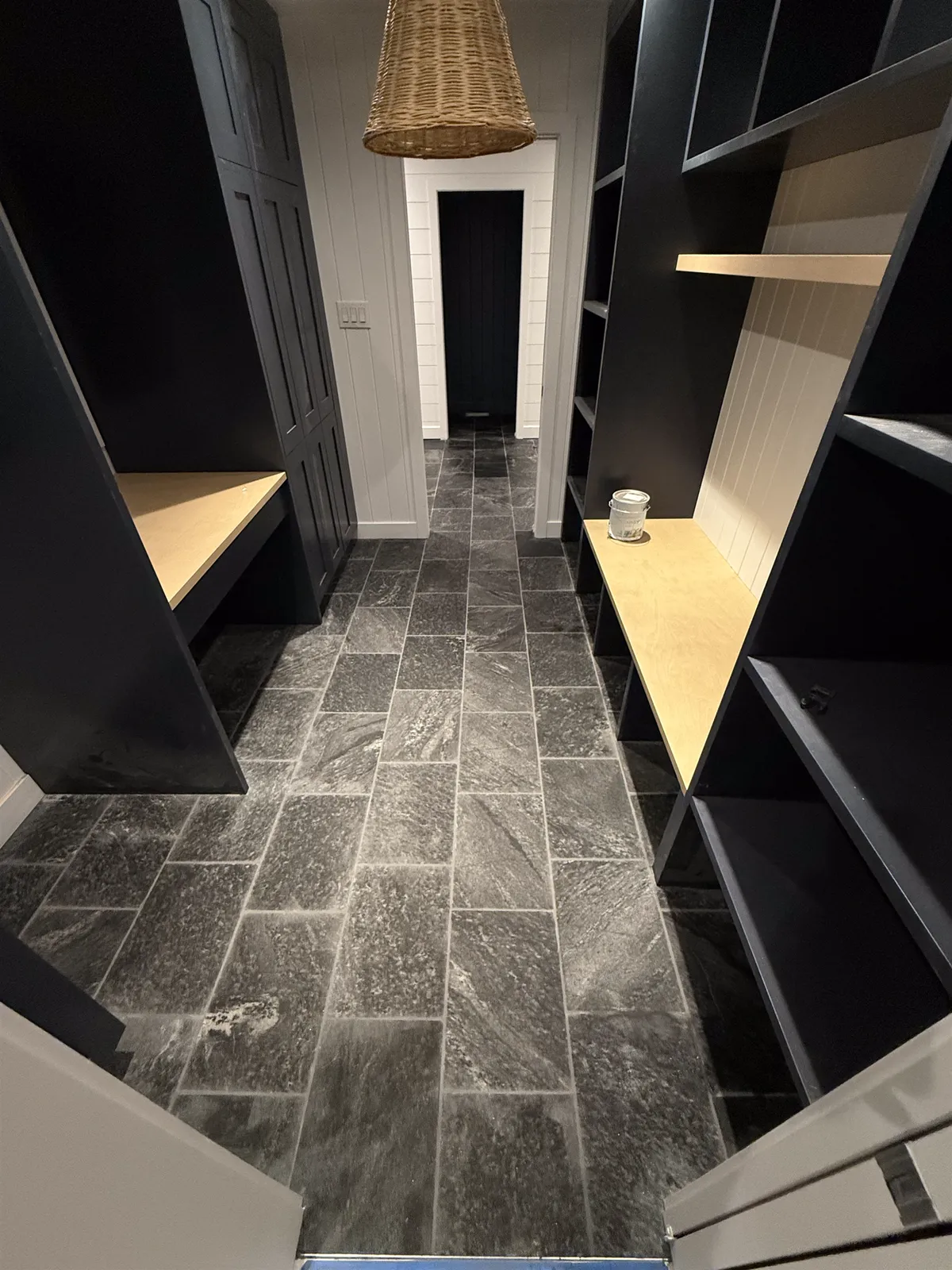
Colours run from ivory and cream through beige, walnut and gold to silver and grey, depending on the quarry. Some travertine is cut across the layers, which gives a cloudy, mottled face. Some is cut along them, which shows parallel bands. Ask which cut you are looking at, because the two look very different across a whole floor.
Because it is calcium carbonate, travertine reacts with acids and scratches more easily than porcelain. It also absorbs water, oil and pigment unless it is sealed. None of this makes it a poor choice. It means travertine has to be chosen, installed and cared for as stone. If you love the look but not the upkeep, a travertine-look porcelain is the low-maintenance alternative; our guide to porcelain vs ceramic tile explains why porcelain needs so little care.
Filled vs unfilled travertine
Filled travertine has its holes filled at the factory, usually with a cement-based filler or a resin tinted close to the stone. The face is then honed or polished smooth. Most indoor travertine floors and walls are filled, because open holes on a floor collect dirt and are hard to mop. Over time, a little fill can loosen under traffic and leave a small pit. That is normal for the material. Pits can be refilled with grout, a stone filler or a colour-matched epoxy.
Unfilled travertine keeps its holes open. It has a rougher, more rustic texture and is often used in tumbled form. Indoors, the open holes catch grit, soap and grout. During grouting, many installers press grout into the open holes as they go, which partly fills them and changes the look. If you want the open texture to stay open, agree on that before grouting starts, and expect more cleaning.
Honed, polished and tumbled finishes
The finish changes how travertine looks, how slippery it is, and how much etching and wear show. Here are the common ones.
| Finish | Look | Best for | Watch for |
|---|---|---|---|
| Honed | Smooth, flat, matte | Floors, bathrooms, showers | Shows stains if not sealed |
| Polished | Shiny, deeper colour | Walls, backsplashes, low-traffic floors | Slippery when wet; shows etch marks |
| Tumbled | Rounded edges, aged surface | Rustic floors, backsplashes, mosaics | Uneven faces; wide joints; more grout |
Honed is the most common choice for travertine floors. It has more grip than polished, and the dull marks left by acids blend into a matte surface. Polished travertine looks rich on a wall or a backsplash, but on a bathroom floor it is slippery when wet and every etch mark shows. Tumbled travertine is made by rolling small tiles in a drum with grit, which rounds the corners and wears the face. It gives the old-world look many people want in a kitchen or mudroom, at the cost of wider joints and more grout to keep clean.
Choosing travertine tile: grades, sizes and blending
Suppliers sort travertine into grades with names such as premium, standard or commercial. These describe how many holes and fills the stone has, how even the colour is and how consistent the size is. There is no single industry standard for these names, so one supplier's premium can look like another's standard. Judge the stone you will actually get, from a full box rather than a showroom sample.
Travertine comes in many sizes: mosaics on mesh sheets, small tumbled squares, 12 × 12 and 18 × 18 tiles, 12 × 24 planks and larger slabs. It is also sold in French pattern sets, sometimes called Versailles, which combine several rectangles and squares in a repeating layout. Pattern sets look great but need careful layout and more cutting at the walls.
Natural stone varies from piece to piece, and from one lot to the next. Buy the whole job from one lot, with enough extra for cuts, breakage and pieces you would rather not see in the middle of the floor. Before installation, open several boxes and lay the tiles out so the colours and fills blend across the room. Pieces with heavy fills, cracks or odd colours go to cuts, closets and under the vanity. Keep a few spares for future repairs, because matching stone later is often impossible.
A stiffer floor for travertine and other stone
Natural stone has veins, fissures and layers, and it bends less before it cracks than porcelain does. That is why industry guidance asks for a stiffer floor under stone. Over wood framing, the common limit is L/360 deflection for ceramic and porcelain, and L/720 for natural stone, which means the floor must be twice as stiff. A floor that is fine for porcelain can crack travertine along its natural lines.
Stiffness comes from the joists and the subfloor together. Membrane and backer board makers publish tables for stone that often ask for a thicker subfloor or a second layer of plywood. Their current tables decide, not a rule of thumb. A bouncy floor needs structural work by a carpenter before any stone goes down. Our guide to the right subfloor for tile explains deflection, plywood thickness and concrete slabs in detail.
Over wood, an uncoupling membrane such as Schluter-DITRA is a common layer under stone, used within the maker's stone requirements. Over concrete, shrinkage cracks are bridged with a crack isolation or uncoupling membrane. The floor must also be flat. Larger stone tiles need the same flatness as large-format porcelain, so dips are filled and humps ground before setting. Heated floors work well under stone, and the cable or heating membrane goes in before the tile, with a licensed electrician making the final connection.
Natural stone tile installation: mortar, back-buttering and coverage
Use white mortar. Light travertine and marble can absorb moisture and colour from grey mortar, which shows as a shadow through the stone or a dark frame around each tile. A white, polymer-modified mortar that lists natural stone on the bag is the usual choice. Larger stone needs a large-and-heavy-tile (LHT) mortar. Over a membrane or heating system, use a mortar that system's maker lists. Our guide to which thin-set to use explains the ratings.
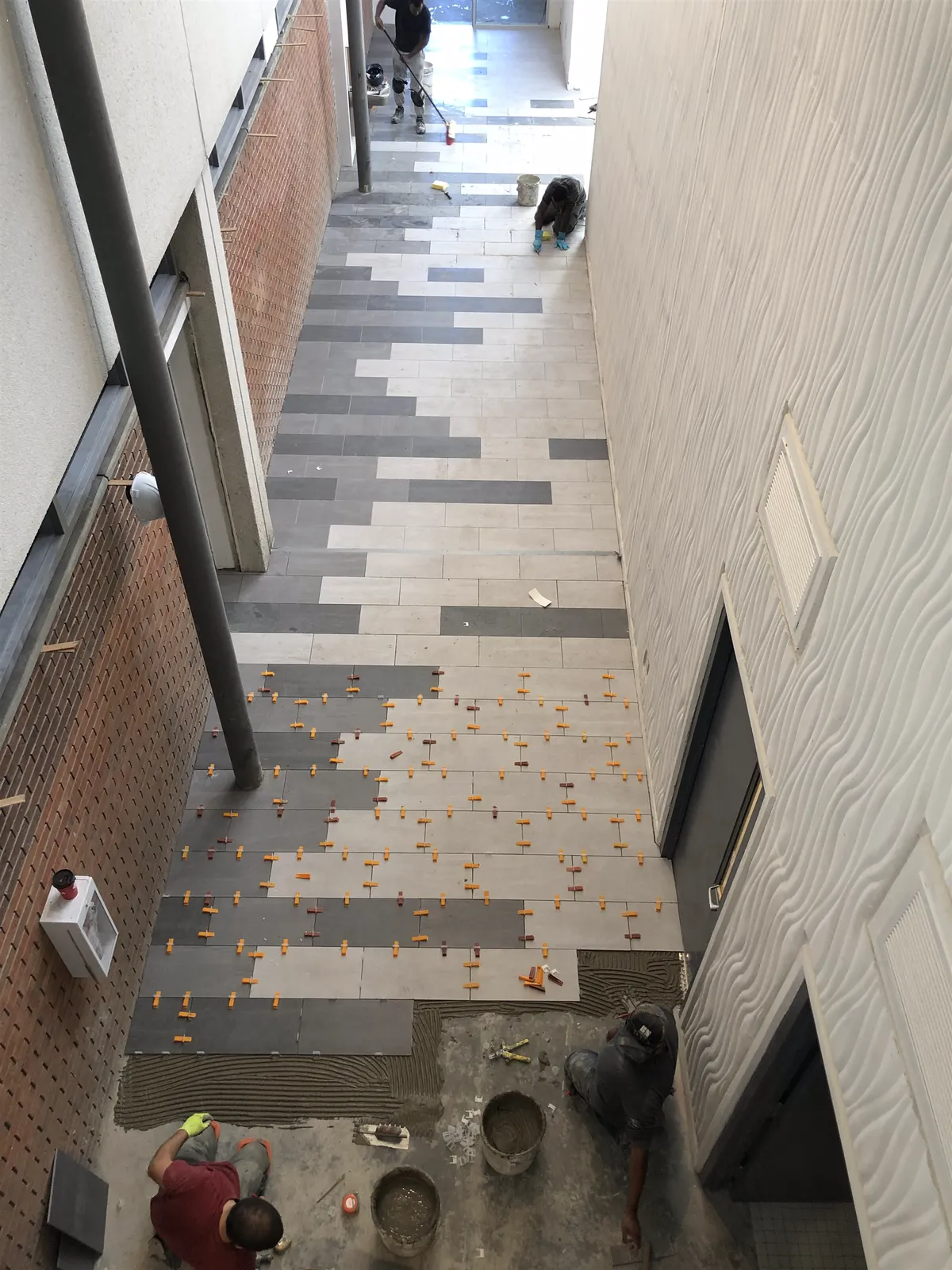
Back-butter every tile. Stone backs are often uneven, with saw marks or hollows. A thin, flat coat of mortar on the back fills them and helps the tile bond across its whole area. The floor is then combed with a notched trowel in straight lines, and each tile is pressed and moved slightly across the ridges to collapse them.
Aim for full coverage. Industry standards call for at least 80% mortar contact in dry areas and 95% in wet areas, with edges and corners supported. Stone suppliers generally ask for full, solid coverage under stone floors. Hollow spots are what crack under a dropped pot or a table leg. Spot-bonding stone on dabs of mortar is a common cause of cracked travertine. Lift a tile now and then to check.
Some stone tiles come with a mesh or resin backing glued to the back. Ask the supplier which mortar suits that backing, because some need a specific setting material. Cut travertine with a wet saw and a blade made for stone. It cuts more easily than porcelain, but edges chip if the cut is rushed. Wet cutting also keeps the dust down. Wear a respirator and eye and hearing protection.
Lippage, thickness and joint width
Most honed and polished travertine tile is gauged, which means ground to a consistent thickness. Gauged stone can be set flat like porcelain, and larger pieces benefit from a levelling clip system. Our guide to lippage and levelling systems explains how clips work and what they can't fix.
Tumbled and some lower-grade stone varies in thickness. Each piece has to be set individually, with more or less mortar, and beaten in until its face sits level with its neighbours. Tumbled stone also has rounded edges and an uneven face, so a small height difference is part of the look. The goal is a floor that feels smooth underfoot and has no edges that catch a sock, not a surface as flat as glass. Natural stone can sometimes be ground and re-polished flat after installation, but that is a job for a stone restoration specialist.
Joint width follows the stone. Polished, gauged stone is often set with tight joints of about 1/16" to 1/8". Tumbled or uneven stone needs wider joints, often 3/16" to 1/4" or more, to absorb the variation in size.
Sealing and grouting travertine
Travertine is porous, and grout is full of pigment. If grout goes onto unsealed stone, the pigment can soak into the surface and the open holes, leaving a haze or a dark frame that won't wash off. That is why stone is usually sealed before grouting, with a penetrating stone sealer or a grout release the stone and grout makers allow. The sealer dries as directed, then grouting starts. Test the grout on a spare piece first, especially with a contrasting colour.
Grout type follows the joint. Unsanded grout suits joints under about 1/8" and polished stone, which sand can scratch. Sanded or high-performance grout suits wider joints, such as tumbled travertine. Epoxy grout resists stains, but on porous stone it can leave a hard haze, so use one approved for stone and test it first. Our guide to grout types compares the options. A grout colour close to the stone's mid-tone looks most natural and hides the small variations in each piece.
Grout stone gently. Use a soft float, clean with a damp sponge and plenty of clean water, and never use acid-based haze removers on travertine. Once the grout has cured, seal the stone and the grout together. The grout maker sets the wait time; our guide on sealing grout covers it. After that, reseal when water stops beading on the surface.
Travertine in showers and bathrooms
A travertine shower is entirely possible. It just asks for more care than porcelain. Like all tile, stone is not waterproof, and neither is grout. The waterproofing is a membrane behind the stone, built and detailed exactly as for any tiled shower. Our guide on how to waterproof a shower walks through it.
On a shower floor, choose honed or tumbled stone, or small travertine mosaics, which have more grip and follow the slope to the drain. Avoid polished stone on any wet floor. Many shampoos, body washes and bathroom cleaners are acidic, and they slowly etch the stone where they drip. Squeegee the walls, rinse soap off the floor, use a stone-safe cleaner, and reseal more often than in a dry room. Light stone often darkens while it is wet and lightens as it dries. Patches that stay dark long after a shower point to water getting behind the stone.
Solid stone pieces finish a stone bathroom neatly: a curb cap, a niche sill or a door threshold in matching or contrasting stone. Our guide to the marble threshold explains how those pieces are supported so they don't crack. For the wider choice of shower materials, see how to choose shower tile.
Acids, cleaners and everyday care
The single most important rule for travertine is to keep acids off it. Vinegar, lemon juice, wine, tomato and many "bathroom" cleaners dissolve the surface of calcium-based stone and leave dull marks called etching. Etching is damage to the stone, not a stain, and on polished stone it often needs professional re-honing. Staining is different: it is colour that has soaked in, usually oil or coffee, and sealing slows it down.
Everyday care is simple. Dust-mop or vacuum often, because grit acts like sandpaper. Damp-mop with a pH-neutral cleaner made for stone. Put mats at entries and felt pads on furniture. Check the sealer with the water test now and then. Our full guide to natural stone care explains the water test, etching and stain removal.
Marble tile installation: what changes
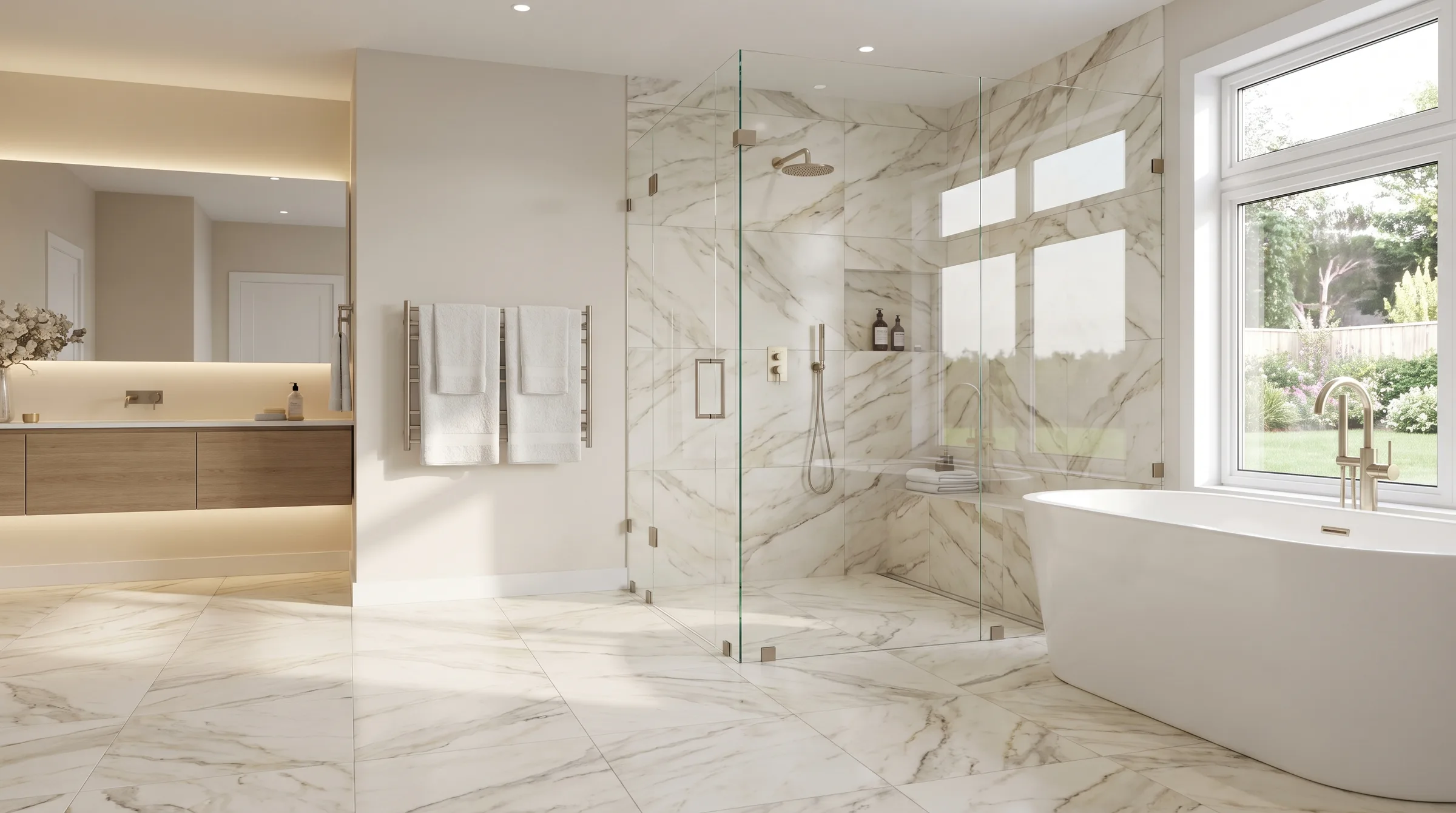
Marble tile installation follows the same principles as travertine: a floor stiff enough for stone, white mortar, back-buttering, full coverage, and sealing before and after grouting. Marble is a metamorphic stone, recrystallised limestone, so it is also calcium-based and etches with acids. Polished marble shows etching and scratches even more than travertine.
White and light marble can be slightly translucent, so grey mortar or uneven trowel ridges can show through as shadows. That makes white mortar and solid, even coverage even more important. Polished marble is usually set with tight joints and unsanded grout, because sand scratches the polish during grouting.
Some stones need special handling. Some green marbles, and certain other stones, are moisture-sensitive: in an ordinary water-based mortar they can warp, curl or stain. They need a special setting material, such as an epoxy or a very rapid-setting mortar, as the stone supplier specifies. Ask about it before you buy, not on installation day. Slate is tough and hides dirt, which makes it a strong choice for entries (see our guide to entryway tile). Limestone is softer than most travertine. Granite is hard and less porous, though it still benefits from sealing.
Is travertine tile a DIY job?
A small travertine mosaic backsplash on a flat wall is a reasonable DIY project for someone patient and careful about sealing before grouting. A floor or a shower is a different matter. The floor stiffness has to be checked, the stone back-buttered piece by piece, uneven stone beaten flat, and the sealing and grouting done in the right order. Mistakes with stone are hard to undo, and the material itself is often the most expensive part of the job.
Cost depends on the stone, its size and finish, the pattern, any subfloor work, and the extra steps stone needs, such as blending, sealing twice and setting uneven pieces. Our guide to tile installation cost in Ottawa explains how those factors add up. Agora installs travertine, marble, slate and other natural stone as part of our tile and stone installation work, and every quote is written.
Frequently asked questions
Is travertine good for bathroom floors?
Yes, if it is honed or tumbled for grip, set on a stiff floor, and kept sealed. It needs more care than porcelain, because acids and many bathroom cleaners etch it.
Should I choose filled or unfilled travertine?
For most indoor floors and walls, filled travertine is easier to clean and keep looking even. Unfilled stone gives a more rustic texture, but the open holes collect dirt, soap and grout.
Does travertine need to be sealed?
Yes. It is usually sealed before grouting to stop grout staining it, sealed again once the grout has cured, and resealed when water stops beading on the surface.
Can you use travertine in a shower?
Yes, with a proper waterproofing membrane behind it, a honed or tumbled finish on the floor, and regular resealing. Rinse acidic shampoos and cleaners off the stone.
Is travertine slippery when wet?
Polished travertine is. Honed and tumbled finishes have more grip, and small mosaics add grout lines that help on shower floors.
What colour thin-set should I use for travertine?
White mortar. Grey mortar can shadow through light stone or darken the edges of each tile. Use a modified mortar that lists natural stone on the bag.
What grout is best for travertine?
Unsanded grout for tight joints on honed or polished stone, and sanded or high-performance grout for the wider joints of tumbled stone. Test the colour on a sealed spare piece first.