
Short answer
A steam shower is a tiled shower sealed from floor to ceiling, with a steam generator that fills it with hot vapour. Beyond a normal shower, it needs glass and a sealed door to the ceiling, vapour-resistant waterproofing on the walls and ceiling (Schluter specifies KERDI-DS for steam showers), a ceiling that slopes so condensation runs off instead of dripping, dense tile with grout that handles constant heat and moisture, and a generator installed outside the shower by the plumber and electrician.
A steam shower turns a bathroom into a small steam room. It is one of the most requested luxury upgrades in a bathroom renovation, and one of the least forgiving. A normal shower gets wet for a few minutes and then dries. A steam shower fills with hot vapour for a long session, and that vapour pushes into every joint, seam and wall cavity. This guide covers what a tiled steam shower needs beyond a standard shower: the enclosure, steam shower waterproofing, the ceiling, the tile, the bench, the generator and ventilation.
What makes a steam shower different
In a regular shower, liquid water runs down the walls and floor to the drain. The waterproofing stops it, and the room dries once the fan runs. In a steam shower, the main load is vapour, not liquid water. Hot, humid air under slight pressure tries to move through the walls and ceiling toward the cooler, drier side. A membrane that stops liquid water perfectly can still let some vapour through.
That changes three things. The waterproofing on walls and ceiling has to resist vapour, not just water. The enclosure has to be sealed, or the steam escapes into the bathroom. And the ceiling becomes a wet surface, because steam rises and condenses there. Everything else follows from those three points.
The heat matters too. Tile, grout, mortar, sealant and trim all go through a hot and humid cycle every session, then cool down. Materials that are fine in a normal shower may not be rated for that. Each product used in a steam shower should be one its maker approves for steam rooms.
A sealed enclosure: glass to the ceiling and the door
A steam shower is fully enclosed. The glass runs from the curb or floor all the way to the ceiling, with no open top. The door is sealed along its edges and bottom, so steam stays in. Some designs include a small operable transom panel at the top that can be opened after use to let the moisture out.
The glass is supplied and installed by the glass company, after the tile is finished. Steam enclosures need more planning than an open-top shower panel. The glass company needs to know the ceiling height, the curb details and the door swing. Doors usually swing out of the shower. The walls and ceiling need solid blocking where the hinges and clamps attach, so that has to be framed in early. Our shower curb guide covers how the curb is built for glass.
Size also matters more than in a normal shower. The steam generator is sized to the volume of the enclosure, so a very large or tall steam shower needs a bigger unit. Many steam showers are built with a lower ceiling than the rest of the bathroom for that reason. A dropped ceiling over the shower also makes the slope easier to build.
Steam shower waterproofing
The waterproofing in a steam shower covers every surface: floor, walls, bench, niche and ceiling, as one continuous layer. It has to stop liquid water and greatly slow vapour. Standard shower membranes are designed for liquid water and some vapour. A steam shower needs a product the maker rates for steam use.
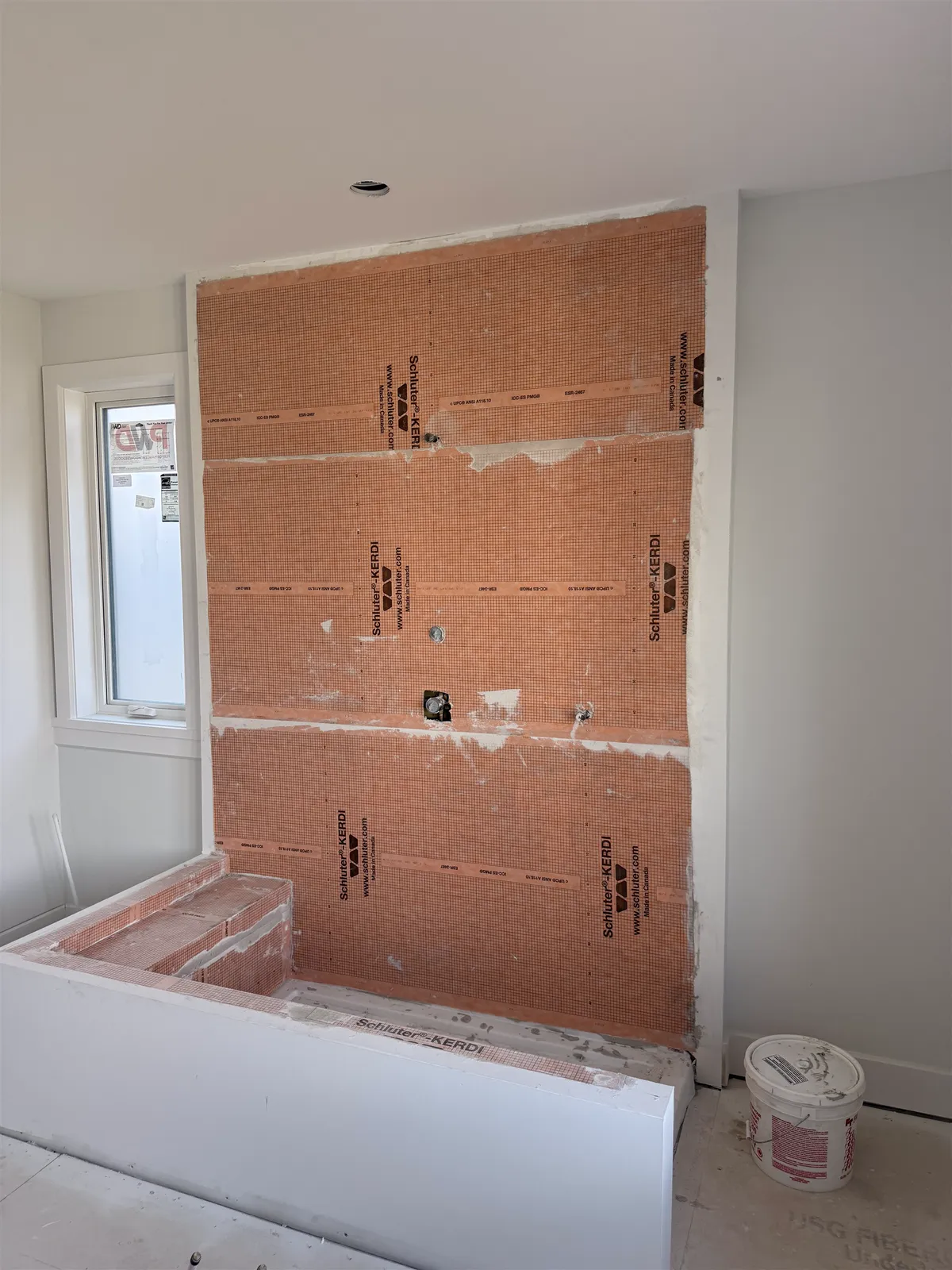
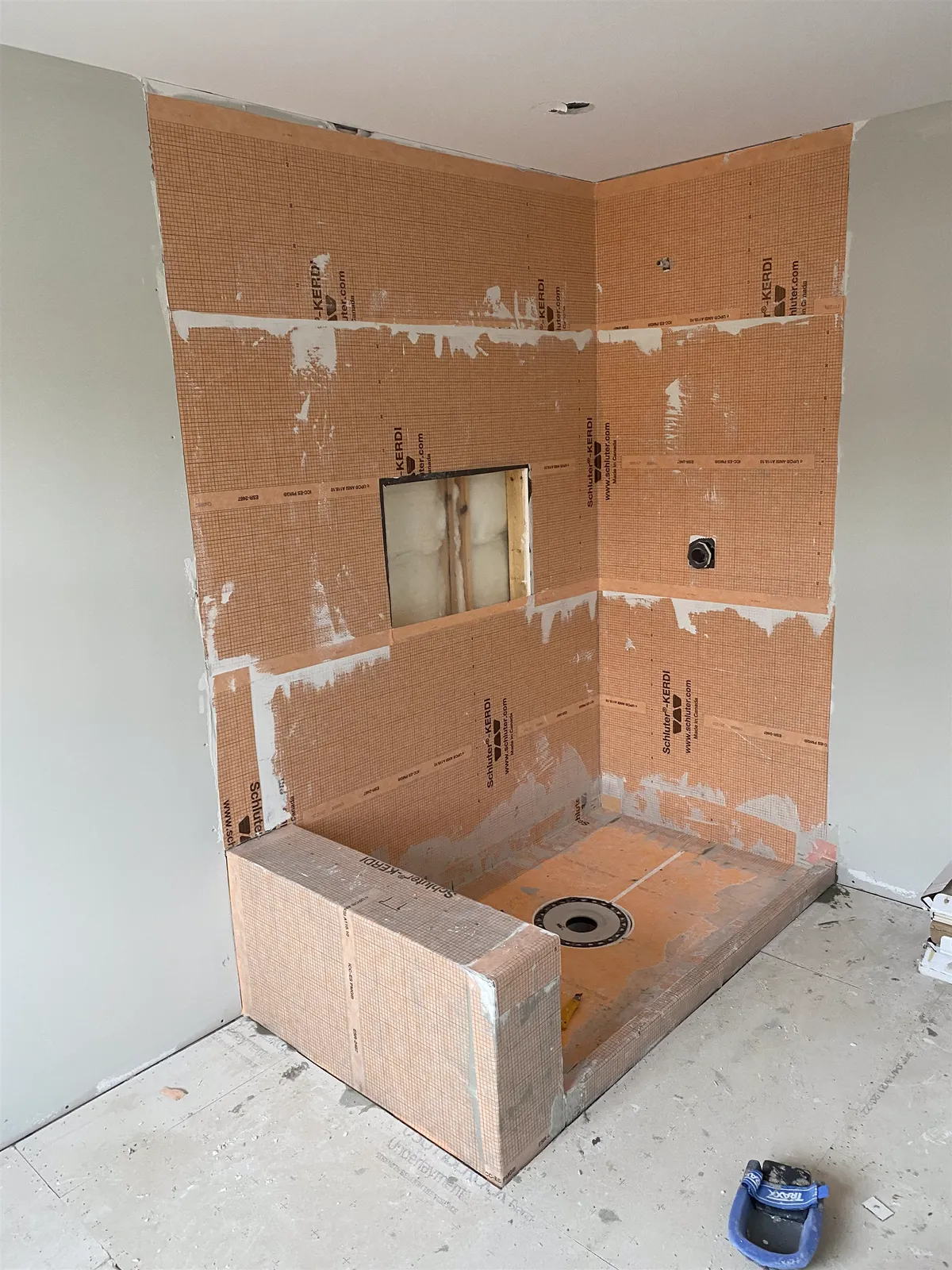
Schluter specifies KERDI-DS for steam showers. It is a version of Schluter-KERDI with much higher vapour resistance, made for steam rooms and other high-humidity spaces. It is installed like KERDI, bonded with thin-set, with every seam and corner sealed as the system requires. Other waterproofing makers have their own steam-rated membranes, including some liquid-applied products. Follow the maker's system requirements for steam, including the seam details, the mortar and the parts used with it.
The maker also decides what goes behind the membrane. In a normal wall, a separate vapour barrier sits behind the board. In a steam shower with a vapour-resistant membrane on the surface, a second barrier behind it can trap moisture in between. Some systems say how to handle this; follow their detail rather than habit.
Ottawa's winters make this more important. A steam shower on an exterior wall or under a roof has hot vapour on one side and freezing air on the other. Any vapour that gets into the wall condenses in the insulation. Interior walls are the safer choice. If an exterior wall can't be avoided, the insulation and vapour control have to be planned carefully. The basics of shower waterproofing are in shower waterproofing explained, and the order of work in how to waterproof a shower. Agora has waterproofed more than 350 showers with Schluter-KERDI, and a steam shower uses the same discipline with a stricter product.
The steam shower ceiling
Steam rises and condenses on the coolest, highest surface, which is the ceiling. On a flat ceiling, the droplets grow and fall, often on whoever is sitting on the bench. Cold drips during a steam session are the most common complaint about a badly built steam shower.
The fix is a sloped ceiling. Most makers call for a slight slope so condensation runs along the ceiling to a wall and down, instead of dripping. Figures of about 1" to 2" per foot are often cited, but the waterproofing and generator makers' instructions decide. The slope should run away from the bench and the door, so water travels down the wall behind the user, not over them.
The slope is built into the ceiling framing or strapping, before the board and membrane go on. That is much easier when it is planned before drywall, especially if the ceiling is being dropped anyway. The ceiling is then tiled over the membrane, which means overhead tile work with support for larger tile while it sets. Our guide to shower ceiling tile covers layout, mortar and the wall-to-ceiling corner.
Steam shower tile and grout
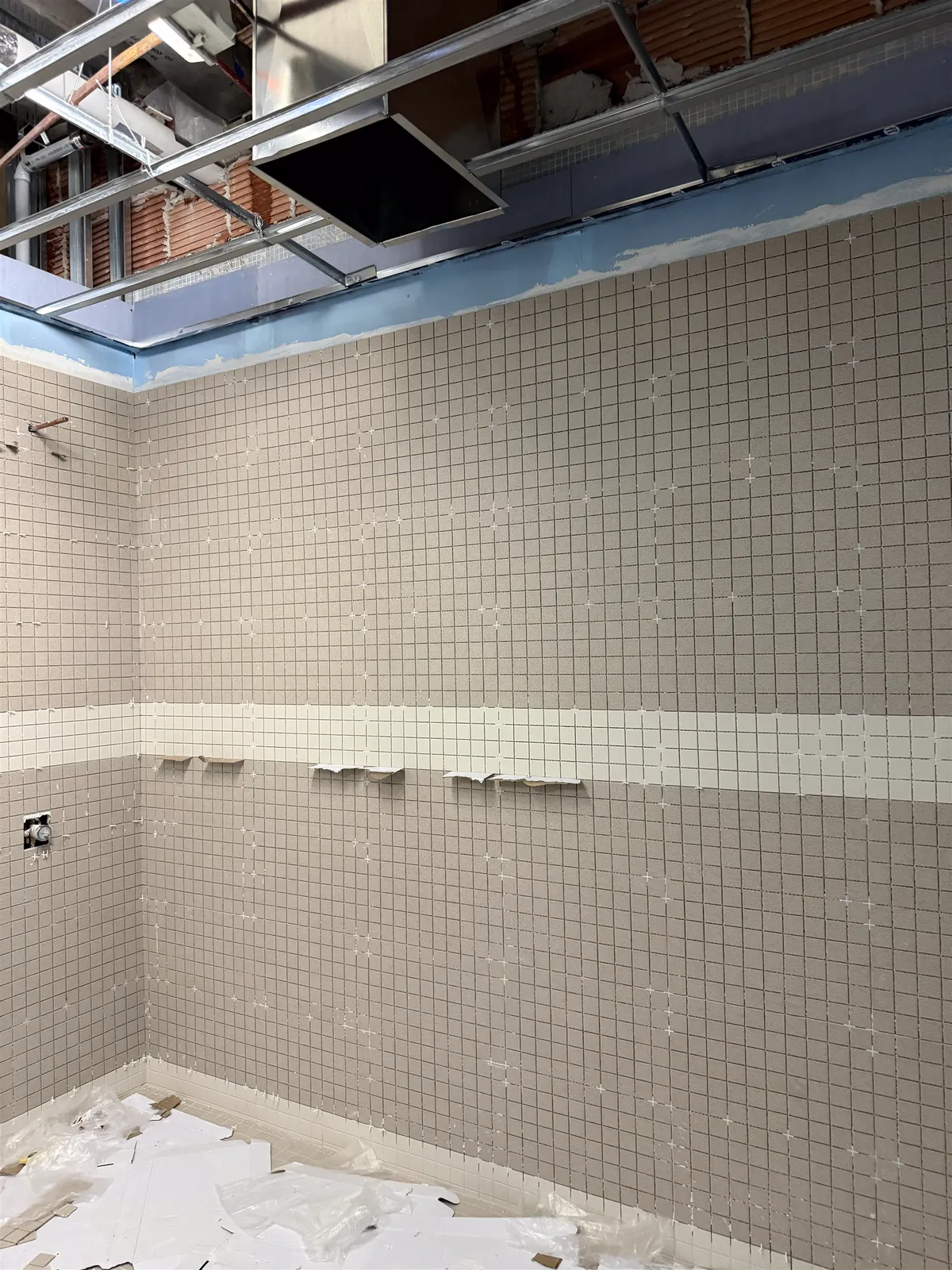
Tile in a steam shower faces heat and constant moisture. Porcelain is the usual choice. It is dense and absorbs very little water, so it doesn't swell or stain. Glass mosaics also work well. Dense natural stone, such as granite, can be used, but softer and more porous stones absorb moisture and are more prone to staining and etching. If you want natural stone, check with the supplier that it suits a steam room and plan for sealing. Our guide to choosing shower tile compares materials.
Grout is where most steam showers show wear first. Cement grout is porous, so it holds moisture and can grow mildew. Epoxy grout is dense, doesn't need sealing and resists the heat and moisture well, which is why it is often recommended for steam showers. It costs more and takes skill to install. Some high-performance cement grouts are rated for steam rooms too; check the label. Our comparison of epoxy vs cement grout explains the trade-offs.
The mortar must be one the membrane maker approves, and the coverage has to be thorough. Industry standards call for about 95% mortar coverage in wet areas. In a steam shower, a hollow behind a tile is a pocket where moisture collects. Inside corners and changes of plane get flexible sealant, not grout, and the heat cycle makes that rule more important. See tile movement joints.
Metal trim should suit the conditions. Stainless steel profiles are a common choice in steam showers because they resist heat and moisture well; our tile edge trim guide compares the materials.
The bench
A steam session lasts long enough that people sit, so almost every steam shower has a bench. It is built solid, waterproofed with the same vapour-resistant system as the walls, and its seat slopes slightly so water runs off. A one-piece slab of stone or porcelain makes a seat with no grout joints to absorb moisture.
The bench position is planned with the steam head and the ceiling slope. The seat should be away from the steam outlet, and the ceiling should slope so condensation runs down a wall away from it. Our shower bench guide covers sizes, framing and finishing the seat.
The steam generator and steam head
The steam generator is a small boiler that makes the steam. It sits outside the shower, in a nearby vanity, closet, attic or basement space, within the distance its maker allows. A pipe carries the steam to a steam head inside the enclosure. The generator needs a water supply, a drain or relief connection as the maker requires, and a dedicated electrical circuit.
This is work for licensed trades. The plumber installs the generator, the steam line and the water supply. A licensed electrician runs the circuit, with an ESA permit where required. Agora Flooring doesn't do plumbing or electrical work; our part is the board, waterproofing and tile, built around what those trades install.
Generator makers size the unit to the enclosure's volume and adjust for its materials. Tile, stone and glass take different amounts of energy to heat, and an exterior wall or a high ceiling needs more capacity. The plumber or supplier works out the size from the shower's dimensions and finishes.
The steam head comes out very hot, so it is placed where people won't touch it or sit beside it, usually low on a wall away from the bench and door, as the maker specifies. The control panel goes inside the enclosure, in reach of the bench. Plan an access panel for the generator so it can be serviced, and decide all locations before the walls are closed.
Lights, openings and penetrations
Every pipe, light, control and steam head goes through the waterproofing, and each one is a potential path for vapour. They are sealed with the system's collars, sealants or methods before tile. Fewer penetrations is better in a steam shower, so plan them carefully.
Lights inside a steam shower must be rated for steam, not just wet locations. They are installed by the electrician. As with any tiled ceiling, place them where the tile layout puts them on a tile centre or joint line. Turn off power at the breaker before anyone works near the boxes.
Ventilation and drying after use
A steam shower is sealed while it runs, but it must dry afterward. If it stays closed and humid, mildew grows in the grout and sealant, and moisture keeps pushing into the walls. Drying it out is part of normal use.
The bathroom needs a good exhaust fan. Designs vary: some put the fan just outside the enclosure, others inside with a control that runs it only after the session. Follow the generator maker's guidance. After each use, opening the door or transom and running the fan clears the moisture. A quick squeegee of the walls and bench helps the grout last.
Steam showers in condos and older houses
In a condo, a steam shower raises extra questions. The building may restrict generators, electrical loads, plumbing changes or moisture-producing fixtures, and the work usually needs approval. Ask the condo for its rules in writing before planning; our condo flooring rules guide lists what to ask.
In older Ottawa houses, the main issues are the electrical service, the wall structure and exterior walls. Adding a dedicated circuit may need panel capacity. Walls may need to be opened to the studs anyway. Older houses also tend to have shower walls on exterior walls, which is the case to avoid for steam. If the house is older and you are opening old tile, test for asbestos in old materials before disturbing them.
Planning and cost
A steam shower costs more than a standard tiled shower because of the generator, the extra trades, glass to the ceiling, a vapour-resistant membrane, a sloped and tiled ceiling, a bench and often epoxy grout. Each of those adds material and labour. For typical shower budgets and the factors behind them, see the cost to tile a shower in Ottawa and the bathroom renovation cost guide.
Plan in this order: the location (interior wall if possible), the enclosure size and ceiling height, the generator location, the bench and steam head positions, the ceiling slope, the glass and blocking, then the waterproofing system and tile. Once the walls are closed, most of those choices are fixed. For how we plan and build tiled showers, see our bathroom and shower tile page.
Frequently asked questions
What waterproofing is needed for a steam shower?
A membrane rated for steam, covering the floor, walls, bench and ceiling as one continuous layer. Schluter specifies KERDI-DS for steam showers, and other makers have their own steam-rated products. Follow the maker's system requirements.
Does a steam shower ceiling need to be sloped?
Yes. Most makers call for a slight slope so condensation runs to a wall instead of dripping on you. Slope it away from the bench and the door.
What is the best tile for a steam shower?
Porcelain is the usual choice because it is dense and absorbs very little water. Glass mosaic and dense stone also work. Softer, porous stones are more likely to stain and need more care.
Do you need epoxy grout in a steam shower?
It is often recommended, because it is dense, doesn't need sealing and resists heat and moisture. Some high-performance cement grouts are also rated for steam rooms; check the product label.
Where does the steam generator go?
Outside the shower, in a vanity, closet, attic or basement space within the distance the maker allows. It is installed by a plumber, with a dedicated circuit run by a licensed electrician, and needs an access panel for service.
Can you convert a regular shower into a steam shower?
Usually only by rebuilding it. The walls and ceiling need a vapour-resistant membrane, the ceiling usually needs a slope, and the glass has to go to the ceiling. Those changes mean taking the shower back to the studs.
Does a steam shower need a fan?
Yes. The bathroom needs a good exhaust fan to clear the moisture after each session, with the door or transom opened. Follow the generator maker's guidance on where the fan goes.