
Short answer
A tile expansion joint (also called a movement joint or soft joint) is a joint through the tile and setting bed that is filled with a flexible sealant instead of grout, so the tile and the building can move without cracking. Industry guidance calls for them at the perimeter of tiled areas, at inside corners and changes of plane, over joints in the concrete slab, and across large areas at regular spacing, commonly cited as roughly every 20 to 25 feet indoors and closer where tile gets direct sun or moisture. Leave them out and you get cracked grout, hollow tiles and, at worst, tile that tents up off the floor.
Movement joints are one of the least visible parts of a tile installation, and one of the most often skipped. A finished tile expansion joint looks like a grout line that is a little softer to the touch. That small detail decides whether a floor stays quiet for decades or starts cracking along the walls after its first winter. This guide explains why tile needs room to move, where the joints go, what fills them, and what to ask before your tile goes in.
What a tile expansion joint is
Tile, grout and thin-set are rigid. Once they cure, they behave like one stiff plate bonded to the floor or wall. A movement joint is a deliberate break in that plate. It runs through the tile and the mortar down to the surface underneath, and it is filled with something that can stretch and squeeze, usually a sealant.
The names get used loosely. Installers say expansion joint, movement joint, soft joint or control joint, and in tile they usually mean the same thing. Strictly speaking, an expansion joint in a building is a structural joint designed into the concrete or framing. A movement joint in tile is the soft joint the installer leaves to absorb normal movement. The perimeter gap is the movement joint around the edge of a floor, where tile meets walls, cabinets or columns. All of them follow one rule: no grout and no mortar in the gap.
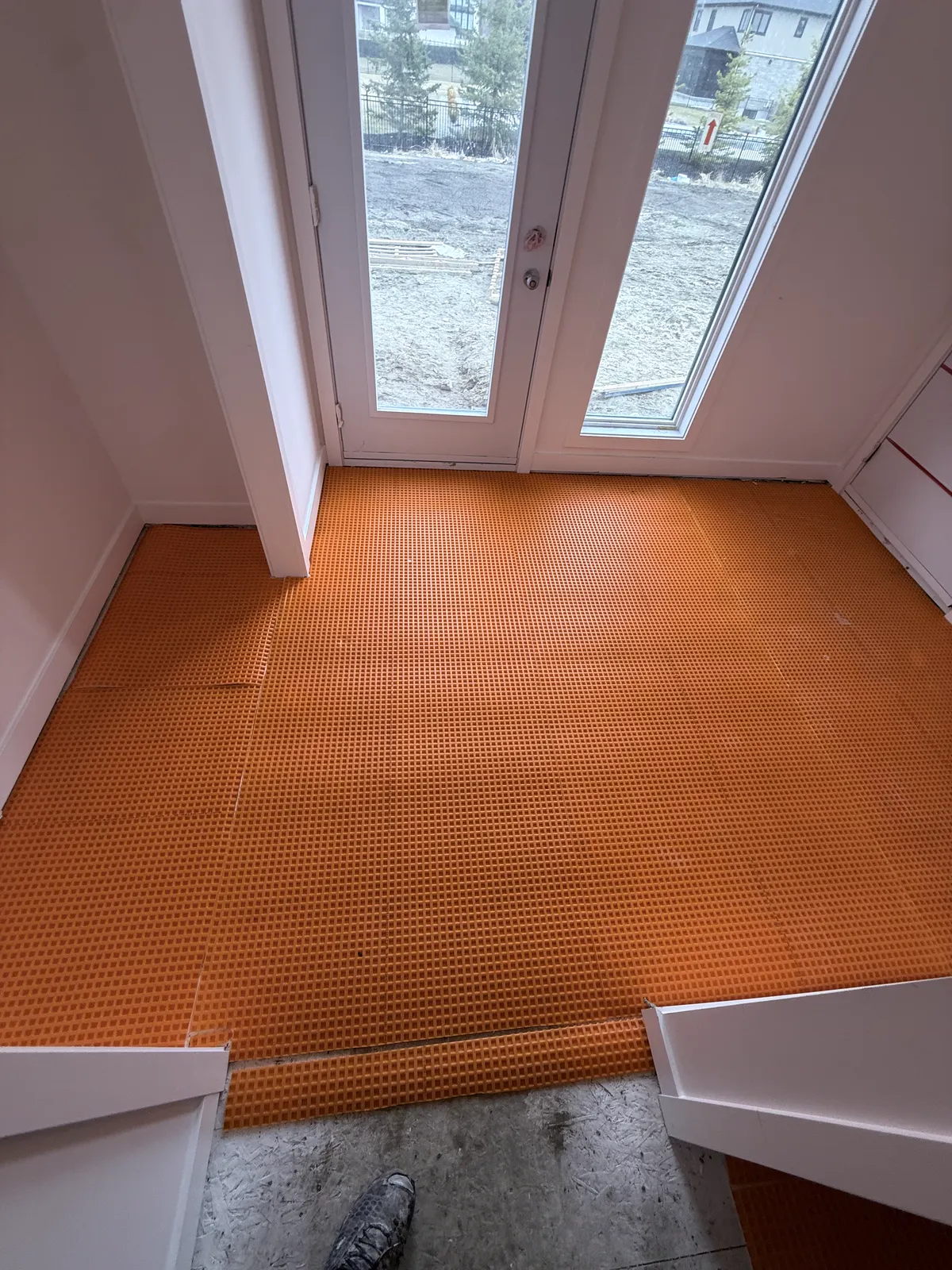
Uncoupling membranes such as Schluter-DITRA help tile cope with small movements in the subfloor, but they don't replace movement joints. The membrane makers' own instructions still call for them.
Why tile and buildings move
Every material in a house changes size a little. Tile moves less than most, but it is bonded to layers that move more, at different rates and at different times.
Temperature is the first driver. Tile and concrete grow as they warm and shrink as they cool, and floors near patio doors and large windows see the biggest swings. Moisture is the second. Wood framing and subfloors swell in humid summers and shrink in the dry heating season. Ceramic tile also expands very slightly with moisture over its life, while the concrete under it is doing the opposite.
New concrete shrinks as it dries, for months. Many standards and makers ask for a new slab to cure for about 28 days before tile, unless the system allows less, and slow shrinkage continues after that. Framing moves too: wood floors deflect under load, and new houses settle as the lumber dries. Finally, sunlight and heated floors warm one part of a floor more than another.
Each movement is small. Across a long run of rigid tile, they add up. If the tile is packed tight against the walls while the slab shrinks and the tile grows, the stress has nowhere to go.
What happens without movement joints
The first sign is usually cracked grout. It shows in corners, along the base of walls and in straight lines across a large floor. Rigid grout in a joint that needs to move will crack, and regrouting it just resets the clock. Our guide to why grout cracks shows how to read the pattern.
The next stage is debonding. The stress pulls the tile away from its mortar, and tiles start to sound hollow when you tap them. They can look fine for a long time while the bond underneath is failing.
The extreme case is tile tenting. A row of tiles lifts off the floor and peaks up like a tent, sometimes overnight and sometimes with a sharp crack. It happens when the tile is under so much compression that the bond lets go. Tenting tends to show up where tile runs wall to wall with no perimeter gap, over a slab that has shrunk, or in a sunny room. Once tile has tented, it has to be taken up and reinstalled with proper joints. Gluing it back down doesn't remove the cause.
Where movement joints go: the industry guidance
In North America the usual reference is the TCNA Handbook, published by the Tile Council of North America. Its movement joint method, known as EJ171, is the one architects, tile makers and setting-material makers generally point to. It is guidance, not a building code, and the project's design professional or the product makers can call for more.
In general terms, it calls for movement joints:
- at the perimeter of tiled areas, where tile meets walls, columns and other fixed surfaces;
- at changes of plane, such as inside corners and where a floor meets a wall;
- over joints in the structure, such as expansion, control and cold joints in a concrete slab;
- where different backing materials meet;
- and through the field of large tiled areas at regular spacing.
For that field spacing, the figures most often quoted are roughly 20 to 25 feet (about 6 to 7.5 m) in each direction for interior tile, and closer, roughly 8 to 12 feet (about 2.5 to 3.5 m), for tile exposed to direct sunlight or moisture, and outdoors. Treat these as typical figures. The current Handbook, the project specification and the makers of the tile, membrane and heating system govern your job, and where they differ, follow the stricter one.
In most houses, movement joints in tile are mainly perimeter and corner joints, because a bathroom or kitchen is smaller than the field spacing. Field joints matter in open-concept main floors, long hallways, basements and commercial spaces.
Where tile expansion joints go in a house
At the walls: the perimeter gap
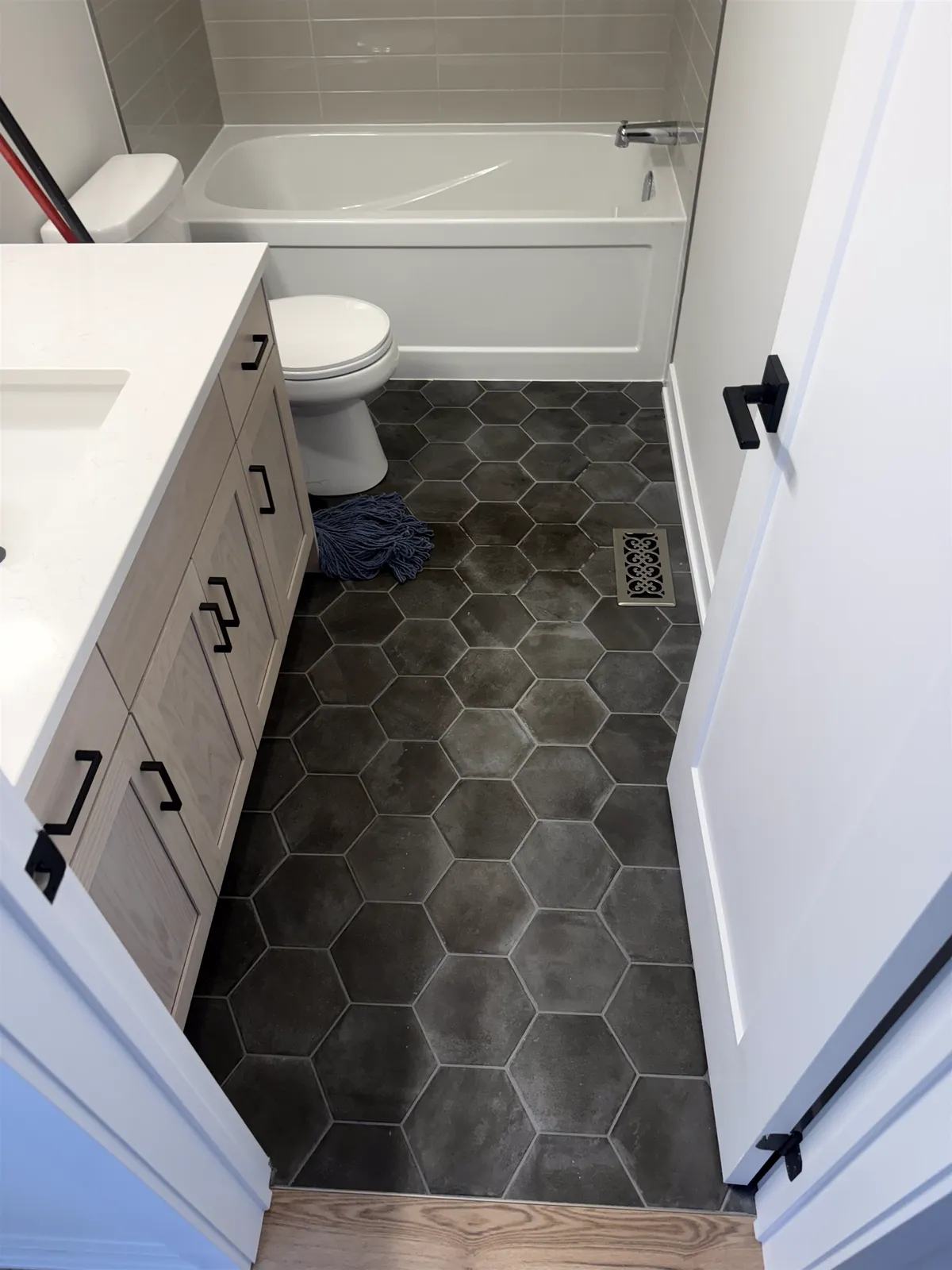
On floors, the tile stops short of the walls instead of being pushed tight against the drywall or the bottom plate. The gap is kept clean of mortar and grout. Where baseboard covers it, it can stay open. Where it shows, for example against a tub, a cabinet run or a stone wall, it is filled with sealant. Tile baseboard sits on top of the floor tile with a soft joint at the bottom, not grout.
At inside corners and changes of plane
Every inside corner on a wall, and every place a wall meets a floor or a countertop, gets sealant instead of grout. The two surfaces move separately, so a rigid joint between them will crack sooner or later.
Around columns, pipes and fixed objects
Columns, pipes coming through the floor and built-in fixtures are fixed points. Tile around them is separated with a soft joint so it doesn't bear against them as it moves.
At doorways and thresholds
Doorways are a natural place for a joint, because two rooms often meet there with different floors and conditions. Where tile meets another floor, the joint is soft. A stone saddle is often set with a soft joint on one or both sides; see our guide to marble thresholds.
Where substrates change
Where a wood subfloor meets a concrete slab, or a wall changes from drywall to concrete block, the two backings move differently. A movement joint goes in the tile directly above the change.
Over joints in the concrete slab
Slabs have joints on purpose: saw-cut control joints, cold joints between pours and structural expansion joints. The rule is to honour them through the tile. A tile movement joint goes directly above each slab joint, so the tile layout is planned around them before the first tile is set. Some crack-isolation and uncoupling membranes allow certain non-structural joints and cracks to be covered, within limits their makers publish. Structural expansion joints are always carried up through the tile, usually with a profile made for the purpose. For more on concrete and wood floors under tile, see what subfloor tile needs.
Movement joints in showers and backsplashes
Showers have more changes of plane than any other tiled space: inside corners, the joint where walls meet the floor or tub, the curb and the edges of a niche. Tile standards and waterproofing makers call for sealant at these joints, not grout, which is why grout in old shower corners cracks so often.
The joint along a bathtub needs particular care. A tub flexes when it fills with water and someone steps in. That joint gets a flexible sealant, and many installers fill the tub with water before sealing so the joint is set at its widest. Behind the tile, the waterproofing has to bridge every corner on its own, with the maker's corner pieces or banding. The sealant is a finishing joint, not the waterproofing. See how to tile a shower for the full order of work.
Backsplashes follow the same logic on a smaller scale. The joint where tile meets the countertop gets sealant, because the counter and the wall move separately. So do inside corners, and the edges where tile meets window trim or the side of a cabinet. Our backsplash installation guide covers this step.
What fills a movement joint
Sealants
Silicone is the usual choice in showers and on walls. It stays flexible, sheds water, and bathroom-grade products resist mildew. Urethane sealants stand up better to foot traffic and are common in floor joints, especially in commercial work. Hybrid sealants sit in between. Many grout makers sell sealants colour-matched to their grouts, so a soft joint can blend in with the grout lines beside it.
Natural stone needs extra care. Some sealants can leave dark stains along the edges of marble and other porous stone, so choose a sealant its maker says is safe for stone. See natural stone care.
Backer rod and bond breaker
A sealant joint works best when it sticks to the two sides of the joint and nothing else. If it also bonds to the bottom, it can't stretch freely and it tears. In deeper joints, a round foam backer rod is pressed in first. It sets the depth of the sealant and keeps it from sticking to the bottom. In shallow joints, a bond-breaker tape does the same job. Either way, the joint has to be clean, dry and free of mortar and grout before sealing, or the sealant lets go at the edges.
Prefabricated movement profiles
Movement profiles are metal or PVC strips with a flexible insert. They are set into the mortar as the tile goes down and finish flush with the tile face. Schluter's DILEX range is a common example, with profiles made for field joints, perimeter joints, inside corners and structural joints. In busy areas a profile holds up better than a bead of sealant, it gives a crisp line, and on many profiles the flexible part can be replaced if it wears. They suit large commercial floors and corridors.
How wide should a movement joint be
There is no single number. The width depends on how much movement is expected, the size of the area, whether the tile is indoors or out, and how much stretch the sealant can handle. The TCNA Handbook gives minimum widths for different situations, and sealant makers publish how much movement their product can take.
A structural expansion joint in the slab sets its own width, and the tile joint above it should generally be at least as wide. In a typical home, corner and field joints are often kept close to the grout joint width so they read as part of the pattern. If drawings or a specification show joint widths, those govern.
Large-format tile, long corridors and commercial floors
Every grout joint takes up a tiny amount of movement. A floor of 24 × 48 inch porcelain has far fewer grout joints than a floor of 12 × 12 tile, so the perimeter and field joints carry more of the load. See our large-format tile guide for the rest of what big tile needs.
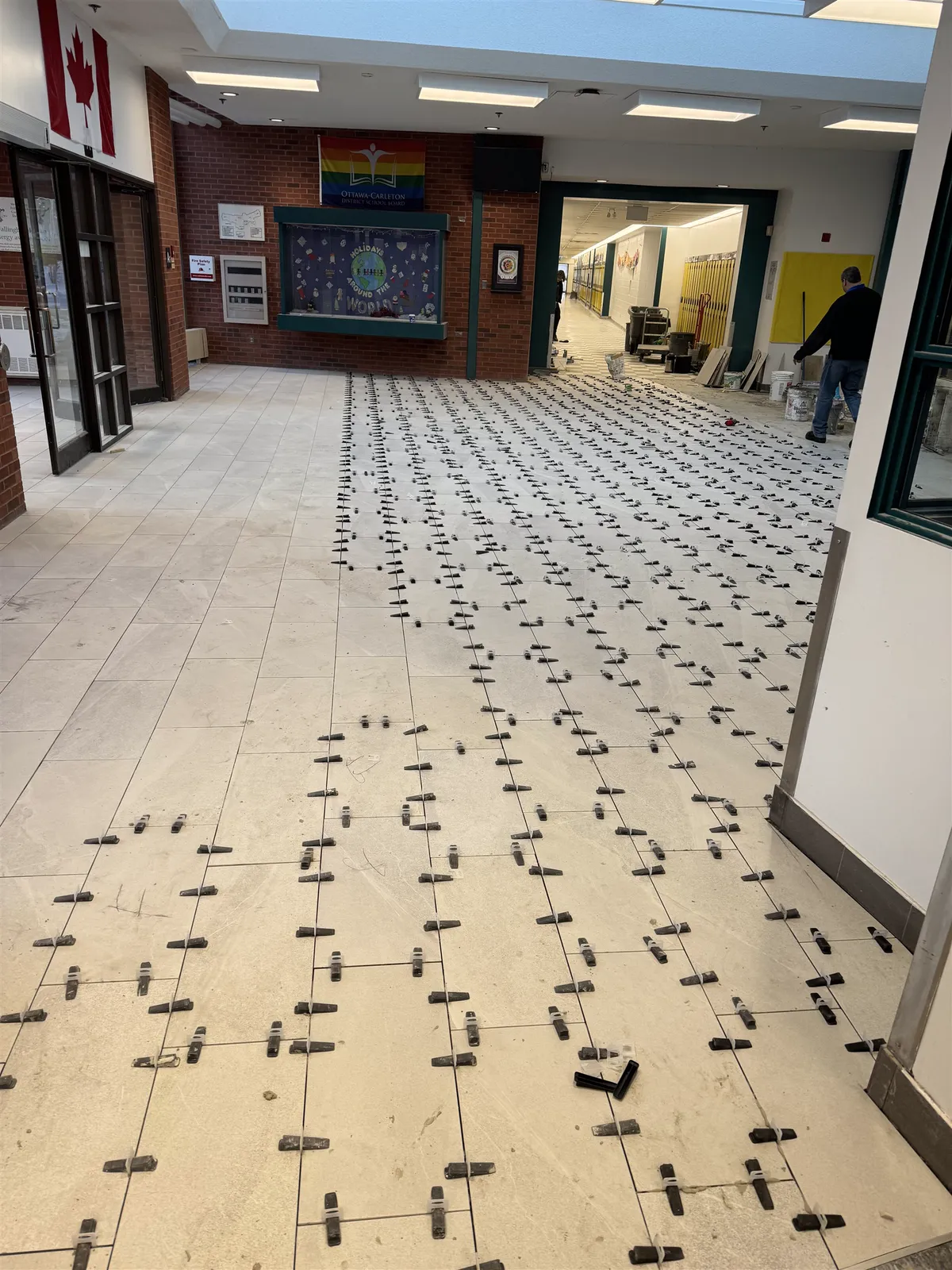
Long corridors, lobbies and open floor plans are where field joints matter most: joints across the run at intervals, plus one over every slab joint below. Field joints sit on grout lines, so the layout is planned to put grout lines where the joints need to be. With a colour-matched sealant, they look like ordinary grout lines. On commercial floors the architect's drawings usually show joint locations, and those drawings govern.
Heated floors and sunny rooms
Electric floor heating warms the tile from below, so heated tile moves more than tile at room temperature. Membrane-based systems such as DITRA-HEAT still need movement joints at the perimeter and in larger areas, as the maker's instructions show. The heat stays off until the mortar and grout have cured. See also our heated floor installation page.
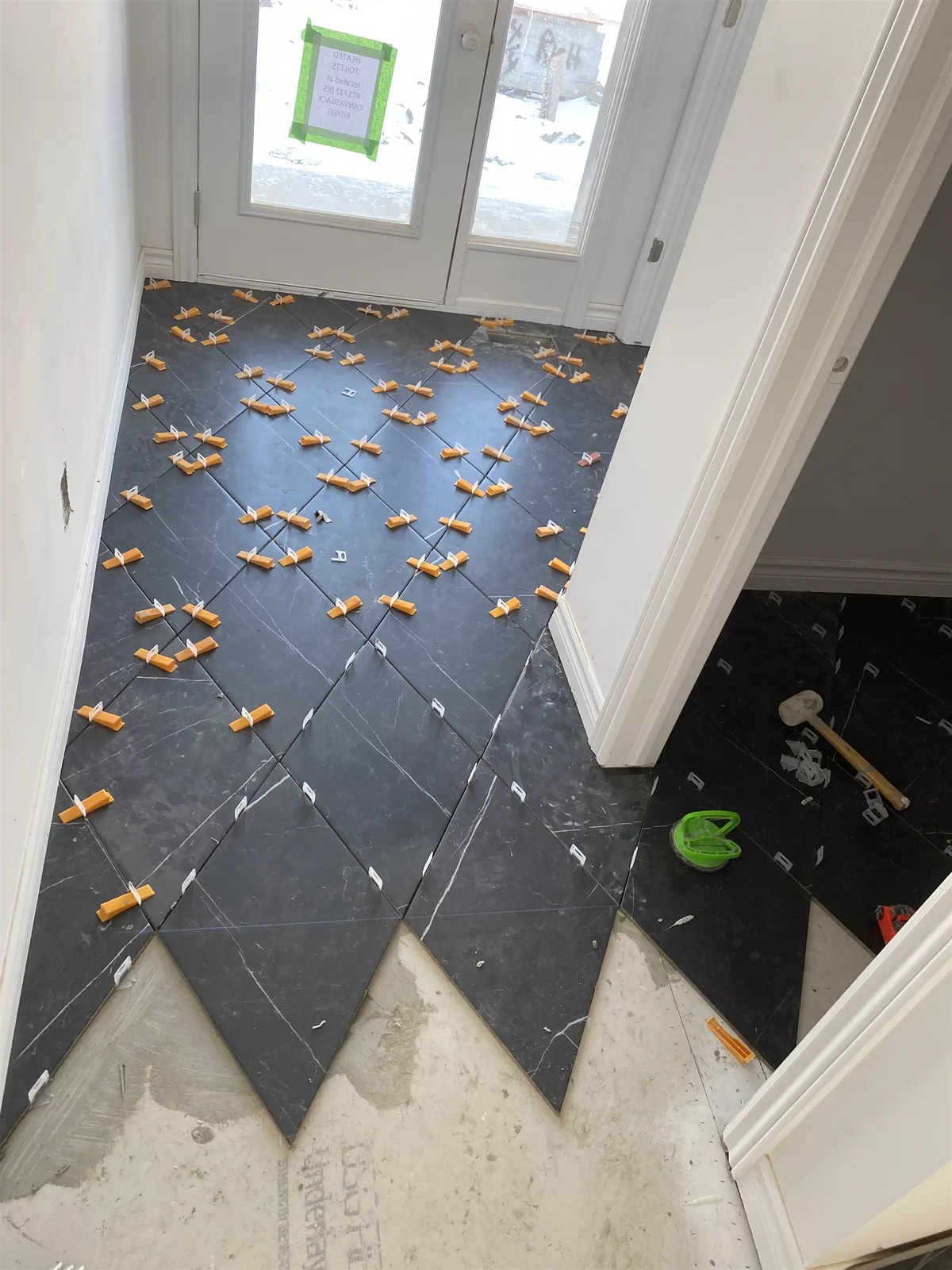
Sun has the same effect. A floor in front of a south-facing patio door, or in a sunroom, can get far warmer than the rest of the house. That is why the industry guidance tightens the joint spacing for tile in direct sunlight. A front entry with floor heating and a big window combines both, so plan the joints there with care.
Movement joints are a maintenance item
Grout can last the life of the floor. Sealant doesn't. It is designed to give, and over the years it hardens, pulls away from the edges or discolours, especially in showers. Expect to replace sealant in wet areas every few years, and whenever you see gaps, peeling or mould that won't clean off.
Replacing it properly means cutting out all the old sealant, cleaning the joint, letting it dry and applying new sealant. New silicone doesn't bond well to old silicone residue, so the joint has to be really clean. Don't fill a failed soft joint with grout; it will crack. If sealant keeps failing in the same place within months, there may be more movement than normal, and it's worth having a tile repair specialist look at it.
What to ask your installer
Before the tile goes in, a few questions tell you whether movement joints are part of the plan:
- Where will the movement joints go, and which guidance or maker's instructions are you following?
- Will the tile stop short of the walls, with the gap kept clean of mortar and grout?
- Are there joints in the slab, and how will the tile layout line up with them?
- Which sealant goes in the corners and soft joints, and will it match the grout?
- Will you use backer rod or movement profiles anywhere?
- Does the membrane or heated floor maker require anything extra?
A careful installer will have clear answers. For more questions worth asking, see how to hire a tile installer, and for the full sequence on a floor, see how to tile a floor.
Frequently asked questions
Does a small bathroom floor need expansion joints?
Usually not in the middle of the floor, because the room is smaller than the typical field spacing. It still needs a perimeter gap at the walls and tub, and sealant instead of grout at inside corners and changes of plane.
Can you grout over an expansion joint?
No. Grout is rigid, so it cracks along the joint and stops the joint from working. Use a flexible sealant or a movement profile, colour-matched to the grout if you want it to blend in.
What causes tile tenting?
Tile tents up when it is squeezed so hard that the bond lets go. Common causes are tile packed tight against the walls, missing field joints in a large floor, a shrinking slab, and heat from sun or floor heating. The tiles have to be lifted and reset with proper joints.
Should I use silicone or grout in shower corners?
Silicone or another sealant rated for wet areas, never grout. Pick a bathroom-grade product colour-matched to the grout, and replace it when it peels or stains.
Does the movement joint go through the mortar too?
Yes. The joint should run through the tile and the setting bed down to the substrate. A joint that is soft only at the surface, with hardened mortar bridging it underneath, can't let the tile move.
Do tile walls need movement joints?
Yes. They go at inside corners, where walls meet floors, tubs and countertops, and on long tiled walls at intervals, much like floors.