

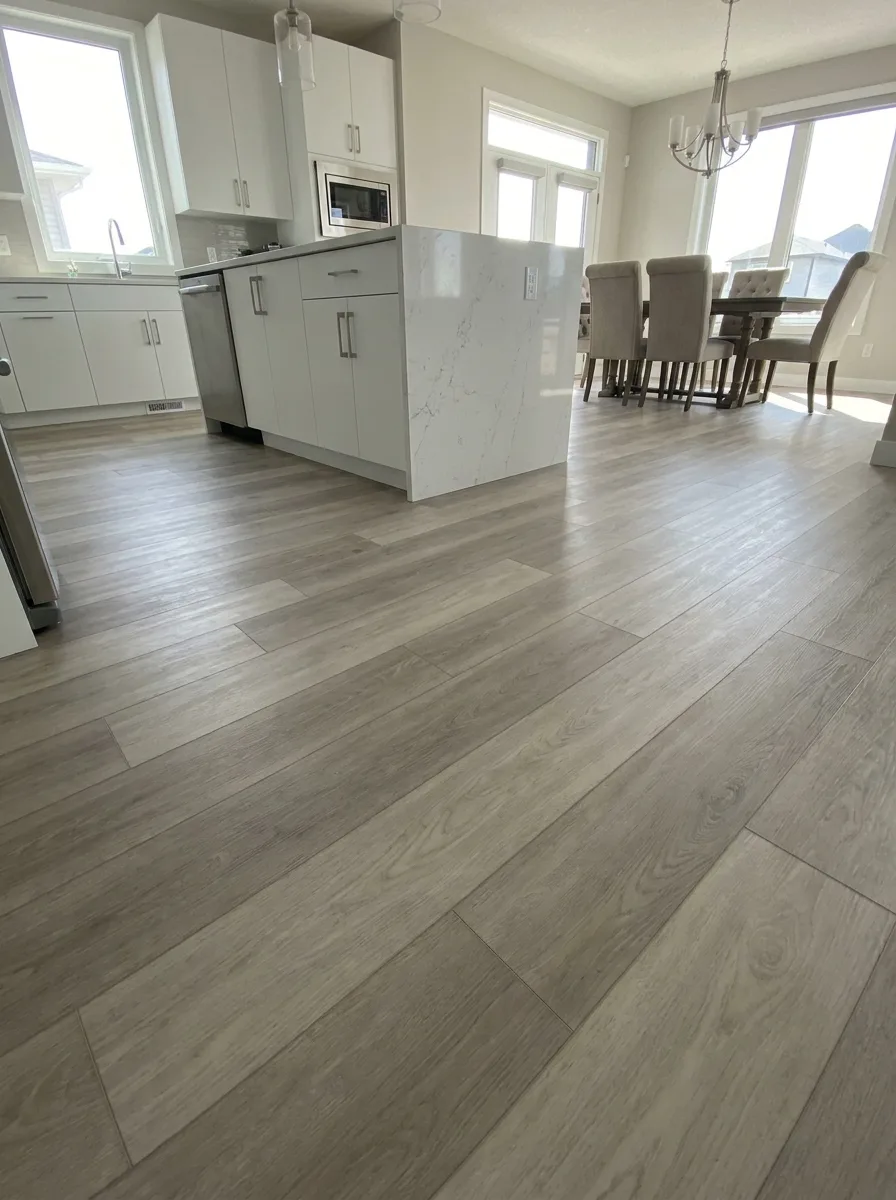
Short answer
The best vinyl plank flooring for your home is the one whose wear layer suits the traffic, whose core suits the room and whose installation rules you can actually meet. Around 12 mil is a common residential wear layer, and 20 mil or more is typical for busy homes with pets and for light commercial use. Total plank thickness says less about durability than the wear layer does. Check the attached pad, the flatness the maker requires and the warranty conditions before you buy.
There is no single best vinyl plank flooring, and brand rankings change every season. What doesn't change is how the planks are built. Every luxury vinyl plank (LVP) has a wear layer, a printed design layer, a core and often an attached pad. Once you know what each layer does, you can compare two samples in a showroom and tell which one will last in your kitchen, your basement or your rental. This guide explains how to judge LVP quality, what the numbers on the box mean, and the installation details that decide whether a good product performs well.
What makes the best vinyl plank flooring
Quality in vinyl plank comes down to four things. The wear layer decides how well the surface resists scratches and scuffs. The core decides how stable, dent-resistant and forgiving the plank is. The locking system and any attached pad decide how well the floor holds together over time. The design layer and surface texture decide whether it looks like a real floor or a photo of one.
Price follows those four things only loosely. A thick, heavy plank with a thin wear layer can wear out faster than a thinner plank with a better one. A beautiful design is wasted if the locks are weak or the product isn't approved for your subfloor. So start with the room. A bedroom with no pets is a different job from an entry where salt and grit come in all winter, or a basement over a concrete slab. Decide what the floor has to survive, then compare products against that.
Some of this you can judge in the store: texture, bevels and print. The wear layer, core, flatness tolerance and warranty conditions are only on the specification sheet and in the installation instructions, so ask for both.
Wear layer: the number that matters most
The wear layer is the clear top layer that protects the printed design. It is measured in mils, which are thousandths of an inch, not millimetres. A 12 mil wear layer is about 0.3 mm thick, and a 20 mil layer is about 0.5 mm. Some labels list it in millimetres, so check which unit you are reading.
As a rough guide, entry-level planks often have a thinner wear layer, in the single digits of mils. Around 12 mil is a common residential choice for bedrooms, living rooms and family homes without heavy wear. Products at 20 mil or more are typical for busy households, pets, entries, kitchens and light commercial spaces. Some commercial lines go thicker still. These are typical ranges, not rules; the maker's own rating for residential and commercial use is the figure that counts.
Most wear layers also have a factory top coat, often a urethane finish, that adds scratch and stain resistance. Makers describe these coatings in their own terms, and they are hard to compare across brands. Treat the coating as a bonus and the wear layer thickness as the main measure. A good wear layer resists everyday scratches, but grit, chair legs and dragging furniture will still mark any vinyl. Felt pads and mats matter as much as the spec; see our guide to vinyl plank care.
LVP thickness: total thickness vs wear layer
LVP thickness is the number most people notice first, and it is the one that misleads most often. Total thickness is the whole plank: wear layer, design layer, core and any attached pad. Click rigid-core planks commonly fall somewhere around 4 mm to 8 mm in total. Glue-down planks are thinner, because the adhesive and the subfloor do the work of holding them flat.
A thicker core does bring real benefits. It feels more solid underfoot, it bridges very small imperfections in the subfloor a little better, and it can sound less hollow. It does not make the surface tougher. Two planks can have the same total thickness and very different wear layers, so always read both numbers.
Thickness also changes the finished floor height. A thick plank with an attached pad, laid over old tile, can stop a door from swinging, crowd a dishwasher or leave a lip at the next room. Measure door bottoms and appliance openings before you settle on a product. Our guide to vinyl plank over tile covers the height question in more detail.
Rigid core vs flexible vinyl
Most click vinyl plank sold for homes today has a rigid core. SPC (stone-plastic composite) has a dense core of limestone and PVC; it resists dents well and is a little harder underfoot. WPC (wood-plastic composite) has a foamed core that feels softer and warmer, but it dents more easily. Flexible vinyl, often called dryback or LVT, is thin and is glued down rather than clicked. Our guide to whether luxury vinyl plank is waterproof explains SPC, WPC and LVT in detail, including why the planks resist water but the floor is not sealed.
For choosing, the practical questions are simple. Will heavy furniture, a piano or an appliance sit on the floor? A dense rigid core handles point loads better. Will people stand for hours, as in a kitchen? A softer core, or a good attached pad, is more comfortable. Is the room a sunroom or does it have very large south-facing windows? Big temperature swings are hard on floating floors, and many makers set limits for direct sun and temperature. Glue-down is often the safer choice there.
A quick showroom check helps. Hold a sample at both ends and flex it gently. A rigid core should barely bend. Look at the edge profile too. Clean, crisp, well-formed locking edges usually mean a well-made plank. Thin, rough or brittle-looking locks are a warning sign, especially for a floor that will be installed in cold weather.
Click vs glue-down, and the attached pad
Click (floating) vinyl is the usual choice for houses and most renovations. It is faster to install and more forgiving of small subfloor flaws. Glue-down vinyl is more stable in very large rooms, sunrooms and commercial spaces with rolling loads, and single planks are easier to replace, but it needs a smoother subfloor and more preparation. Our comparison of click vs glue-down vinyl plank sets out where each one fits.
Many click planks come with a pad already attached to the back, commonly a thin, dense foam or cork layer. An attached pad saves a step, adds a little comfort and reduces the hollow sound a floating floor can make. It also limits your options. Adding a second cushion pad under planks that already have one is the most common way click joints get damaged, and it usually breaks the warranty conditions. If the planks have no pad, use only the thin, dense underlay the maker approves. Over concrete, the maker may still call for a vapour barrier. Our underlayment guide covers all of this.
In a condo, the building's sound rules may decide the question for you. Some buildings accept an attached acoustic pad with a published rating; others require a specific underlay. Get the rules in writing before you choose the plank. See condo flooring rules.
How the best vinyl plank flooring looks real
Every vinyl plank is a printed image under a clear layer. The difference between a convincing floor and an obvious imitation is in the details around that image.
Embossing. Most planks have a texture pressed into the surface. In better products the texture follows the printed grain, so the knots and grain lines you see are also the ones you feel. This is often called embossed in register. A random texture over a printed grain looks fine from a distance but less real up close, especially in raking light from a window.
Bevels. Many planks have a small bevel on the long edges, and sometimes on the ends. A bevel makes each plank read as a separate board, like real wood, and it hides small height differences between planks. Some bevels are painted to match; others show a lighter edge. Square-edged planks give a smoother, more modern look, but they show any unevenness in the floor more.
Plank length and width. Longer, wider planks look more like premium wood and put fewer end joints across the room. They also need a flatter subfloor, because a long plank over a dip flexes more at the joint. Narrow, short planks are more forgiving and suit small rooms and busy layouts.
Print repeats. The design repeats after a set number of different plank faces. A product with few faces shows the same knot or streak again and again across a large floor. Ask how many different faces a product has, or open several boxes in the store and look. During installation, planks from several boxes are mixed so identical faces never sit side by side, as our guide to how to install vinyl plank flooring explains.
Residential vs commercial vinyl plank
Many ranges come in a residential grade and a commercial grade, or carry ratings for both. The commercial versions usually have a thicker wear layer, and they are often glue-down, because offices, shops and clinics have rolling chairs, carts and long continuous areas that are hard on click joints. A commercial-rated product in a busy home can make sense, especially for entries, kitchens and rentals.
The reverse is a common mistake. A residential click plank in a store or office often fails early at the joints and wears quickly in the traffic paths. The warranty usually doesn't cover it either, because commercial use is excluded or covered on different terms. If you are choosing flooring for a business, a rental building or a common area, ask for the commercial rating and the commercial installation instructions. Our commercial flooring page covers the kinds of spaces we install.
Look for an indoor air quality certification too. FloorScore is a common one for vinyl, and it tests for emissions of volatile organic compounds. It is useful for bedrooms, nurseries and any home where someone has sensitivities.
Reading the warranty before you buy
Vinyl plank warranties can sound generous on the box. The conditions in the fine print are what matter, and they vary a lot between products. Read them before you buy, not after a problem appears. Things to look for:
- What is covered. Most warranties cover manufacturing defects and wear-through of the wear layer, not scratches, dents, fading or damage from water under the floor.
- Installation conditions. Following the maker's instructions is usually a condition of coverage: flatness, expansion gaps, approved underlay, acclimation and transitions.
- Subfloor moisture. Over concrete, many makers require a measured moisture test and set limits for the slab.
- Temperature and sun. Some products exclude sunrooms, unheated spaces or direct sun through large windows.
- Commercial use. Residential products often have no commercial coverage, or much shorter terms.
- Proof. Keep the receipt, the product name and the lot numbers from the boxes.
A long warranty on a product that won't be installed to its conditions is worth little. A shorter warranty on a product your subfloor and room actually suit is worth more.
Subfloor flatness, buying from one lot, and transitions
Even the best vinyl plank flooring fails over a poor subfloor. Makers commonly specify a flatness tolerance such as 3/16" in 10 ft, and some add a limit over a shorter span; check your product's figure. A click joint that sits over a dip flexes every time someone steps on it, and over months the lock wears and the joint opens or peaks. Longer, wider planks are less forgiving here. Dips are filled and humps are ground or sanded before the floor goes down, and a wavy floor often gets a pour of self-levelling compound. That preparation is part of the job, not an extra to skip.
Buy all the flooring at once, from one production lot. Colour and texture can shift slightly between runs, and the difference shows when two lots meet in the middle of a room. Most installers add about 10% to the floor area for cuts in a straight layout, and more for rooms with many corners and closets. Keep a spare box or two for future repairs, stored flat in a dry place.
Plan the transitions at the same time as the product. A T-moulding joins floors of about the same height, a reducer steps down to a lower floor, and an end moulding finishes against a sliding door track or a hearth. Many makers sell mouldings that match the plank, and some products need expansion breaks in long open areas or through narrow doorways. Our guide to floor transition strips explains each type.
Choosing vinyl plank room by room
For bedrooms and living rooms, a residential plank around 12 mil with an attached pad is usually plenty, unless you have large dogs. For kitchens, entries and mudrooms, a thicker wear layer and a rigid core earn their keep. In an Ottawa entry, salt, grit and meltwater from boots are the real test, so add a good mat at the door. For bathrooms, the planks are fine around the toilet and vanity, with sealant at the tub, shower and toilet base where the maker calls for it. Vinyl plank is never a shower floor.
For basements, choose a product the maker approves below grade, test the slab for moisture, and use the vapour barrier or underlay the product calls for. Waterproof planks don't fix a wet basement. Our guide to the best basement flooring covers slab checks and the options. If you are still deciding between vinyl and other floors, LVP vs laminate compares the two room by room.
For cost, the product is only part of the price. Subfloor levelling, removal of the old floor, stairs, transitions and trim all add to it. Our guide to vinyl plank installation cost in Ottawa explains what drives the number. A careful installer checks flatness, moisture and door heights before you order, so the product you choose suits the room it goes in. More on our vinyl plank installation page.
Frequently asked questions
What is a good wear layer for vinyl plank flooring?
Around 12 mil is a common residential choice. For pets, kids, entries, kitchens and light commercial use, 20 mil or more is typical. Use the maker's residential and commercial ratings as the final word.
What is the best LVP thickness?
There isn't one best thickness. Click rigid-core planks commonly run around 4 mm to 8 mm in total, and a thicker plank feels more solid. For durability, the wear layer matters more than total thickness.
Is SPC or WPC better?
SPC is denser and resists dents better, which suits most homes and basements. WPC is softer, warmer and quieter but dents more easily. See is luxury vinyl plank waterproof for both.
Is vinyl plank with an attached pad better?
It is convenient and usually comfortable and quieter. The catch is that you can't add another cushion pad under it, and in a condo the building may require a specific underlay instead.
How can I tell if vinyl plank is good quality?
Read the specification sheet for the wear layer in mils, the core type and the flatness tolerance. In the store, look for texture that follows the grain, crisp locking edges and enough different plank faces that the pattern doesn't repeat obviously.
Should I use commercial vinyl plank at home?
It can be a good choice for entries, kitchens, rentals and homes with large dogs, because the wear layer is usually thicker. Check that it is also rated and warrantied for residential use.