Short answer
White oak flooring is a hard, durable wood with a light tan to brown colour, a fairly calm grain and no pink tone, which is why it suits the natural, light and grey looks that are popular now. Compared with red oak, it is slightly harder, tighter-grained and more resistant to water soaking in. It comes as solid or engineered boards, in plain, rift or quarter sawn cuts, and the grade, cut, width and finish decide most of how it looks and what it costs.
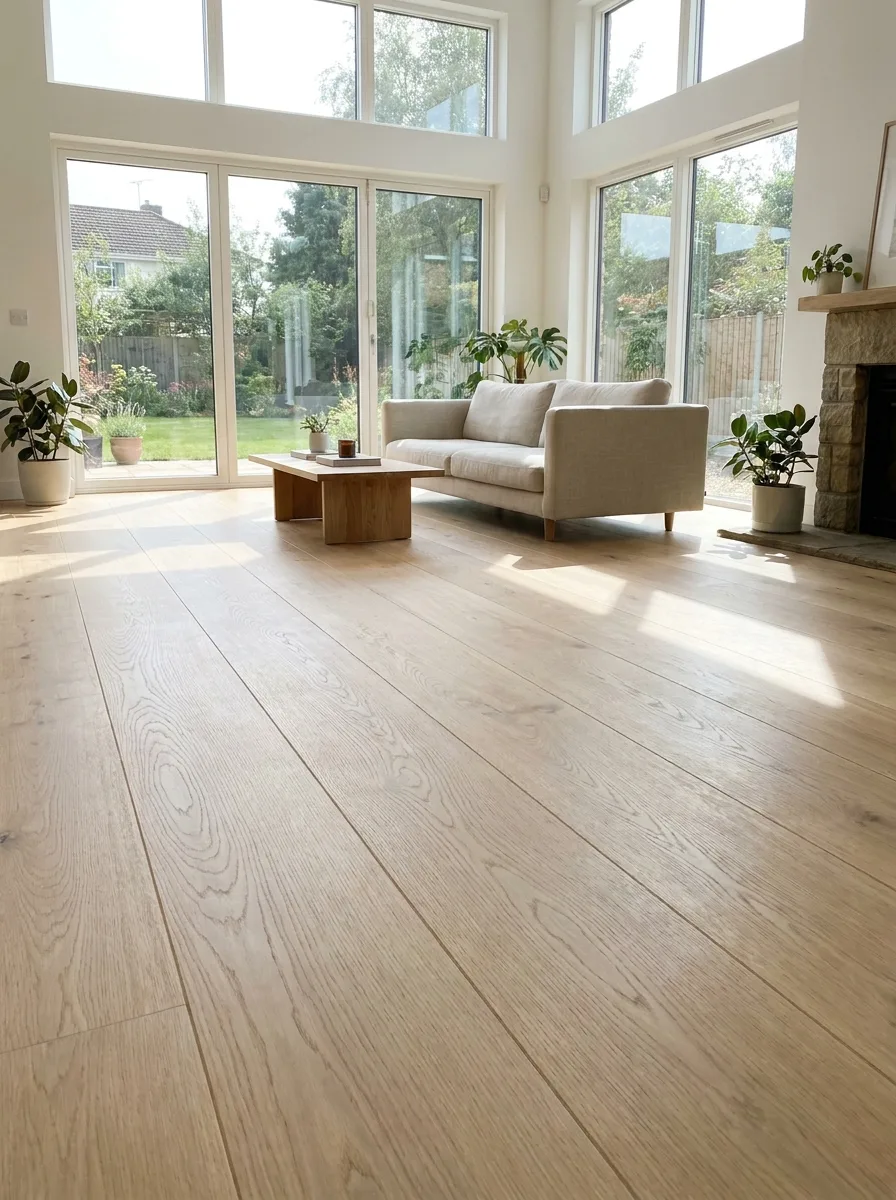
White oak flooring has become the default choice for a light, natural wood floor. Walk through any new build or renovation showroom and much of the hardwood on display is white oak, often in wide planks with a matte finish. It earns that place: it is hard enough for family life, stable enough for engineered boards and plain enough in colour to take almost any finish.
This guide explains what makes white oak different, how it compares with red oak, what the grade and cut names on a sample mean, and how the finish changes the look. It also covers solid and engineered boards, plank widths and what installation needs. If you are still deciding between wood and other floors, our hardwood flooring page shows the options we install.
Why white oak flooring is so popular
Three things make white oak the most requested hardwood in many homes. The first is colour. White oak is light tan to medium brown, sometimes with a slight olive or grey cast. It has none of the pink or orange tone of red oak. That neutral base is what makes the "natural", Scandinavian and greige floors in design photos possible. A clear finish on white oak looks like wood. The same finish on red oak looks warmer and pinker.
The second is the grain. White oak has a quieter, straighter grain than red oak, with fewer large swirls. In rift and quarter sawn boards it becomes very linear, which suits modern rooms. In plain sawn boards it still shows the classic oak cathedral pattern, but in a softer way.
The third is performance. White oak is a dense, hard wood that has been used for floors, furniture, boats and barrels for centuries. It machines well, so makers can mill long, wide and stable engineered boards from it. It also takes stains and reactive finishes well, which gives designers a wide range of colours from one species.
White oak vs red oak
Red oak and white oak are both North American oaks, and both make excellent floors. Red oak was the standard in Canadian homes for decades, so many older floors are red oak. Knowing the difference helps when you are matching an existing floor or choosing a stain.
| White oak | Red oak | |
|---|---|---|
| Natural colour | Light tan to brown, olive or grey cast | Light brown with a pink or reddish tone |
| Grain | Tighter, calmer, long rays that show in quarter sawn boards | Bolder, more open grain with strong cathedral patterns |
| Hardness | Slightly harder | Slightly softer |
| Water | Pores are largely plugged, so it resists water soaking in better | Open pores let water and stain in more easily |
| With stain | Takes greys, naturals and browns evenly | Red tone shows through many stains, especially greys |
On hardness, both oaks sit in the middle of the common floor species. White oak is a little harder than red oak on the Janka hardness test, harder than walnut and softer than hickory or hard maple. In daily life the difference between the two oaks is small. Both dent under a dropped pot or a high heel, and both scratch through the finish under grit. The finish, the sheen and how you care for the floor matter more than the few points between them.
The water difference is real but easy to overstate. White oak's pores are largely filled with natural growths that block water. That is why it was used for barrels and boat building, and why it handles a spill a little better than red oak. It does not make a floor waterproof. Standing water, wet mops and a leaking dishwasher still damage white oak.
If you are matching an existing floor, check which oak it is before ordering. Red and white oak look different side by side, and a stain that matches on one may not match on the other.
Grades: how much character you want
A grade describes how much natural variation the boards show: knots, mineral streaks, colour change between heartwood and sapwood, and small checks. It is about appearance, not strength. A rustic grade is just as strong as a clear one.
Unfinished solid oak is often graded under industry rules with names such as Clear, Select, No. 1 Common and No. 2 Common, from the most uniform to the most character. Prefinished and engineered makers often use their own names instead, such as select, character, natural or rustic. Two makers' "character" grades can look quite different, so judge the boards, not the name.
Cleaner grades give a calm, even floor that suits modern and formal rooms. They also cost more, because fewer boards from each log qualify. Character grades show knots and colour variation, hide wear well and suit farmhouse and relaxed interiors. Ask to see a large sample or several full boards. A single small sample rarely shows the range you will get across a room. When the floor arrives, the installer racks out boards from several boxes so the variation is spread evenly, as described in our hardwood installation guide.
Plain sawn, rift sawn and quarter sawn white oak
The cut is how the board was sawn from the log, and it changes both the look and the stability.
Plain sawn (also called flat sawn) boards are cut straight through the log. They show the familiar cathedral arches and a mix of grain. Plain sawn is the most common and usually the most affordable cut, because it uses the most of each log.
Quarter sawn boards are cut so the growth rings run steeply through the board. The grain is straight, and white oak shows its rays as flecks and ribbons across the face. That fleck is a classic look in older homes and Arts and Crafts interiors.
Rift sawn boards are cut at an angle that avoids most of the fleck. The result is a very straight, linear grain, which is why rift sawn white oak is popular in modern kitchens and minimalist rooms. Rift and quarter sawn boards are often sold together as "rift and quartered".
Rift and quarter sawn boards also move less across their width when humidity changes, and they cup less. That is a real benefit in a climate with big seasonal swings. The trade-off is cost: these cuts get fewer boards from each log, so they are priced higher. A fourth option, live sawn, mixes all the grain patterns from the whole log in one floor and is common in European engineered oak.
Solid or engineered white oak flooring
White oak is sold both ways. Solid boards are one piece of oak, usually 3/4" thick, nailed to a wood subfloor. Engineered boards have a white oak top layer on a cross-layered core, which moves less with humidity. Our guide to engineered vs solid hardwood compares the two in detail, so here is the short version for white oak.
Choose solid white oak for a main floor or upstairs on a wood subfloor, in standard widths, if you want the most sanding life. Choose engineered white oak for concrete, condos, basements rated for it, floors over radiant heat where the maker allows it, and wide planks. Much engineered white oak, especially in wide planks, is European oak, which belongs to the same white oak family and looks very similar.
With engineered white oak, ask about the wear layer: the thickness of the oak on top. It decides whether the floor can be sanded later and how many times. Also ask about the core. A multi-ply plywood core and a composite core behave differently and suit different installation methods. If the floor is going on a slab, read engineered hardwood on concrete.
Plank width and length
Older oak floors were usually narrow strips, around 2 1/4" wide. Today, white oak is often sold in wider planks, and boards of 7" and more are common in engineered lines. Wider boards show more of the grain and give a calmer, more modern look with fewer seams.
Width affects how the floor behaves. Each wide board moves more across its width as humidity changes, so wide solid boards show bigger seasonal gaps and cup more easily. That is why most wide white oak is engineered. Our guide to wide plank flooring covers this in detail, including fastening and subfloor flatness.
Length matters too. Longer boards look better in large rooms, need fewer end joints and make the stagger easier to control. Ask what the length mix is in each box, since some lines include many short pieces. White oak also suits patterns, such as a herringbone hardwood floor, where short boards are made for the layout.
Finishes: oil, urethane and the natural look
The finish protects the wood and decides much of how a white oak floor looks. Most floors today are prefinished in the factory. A smaller share are installed raw and finished on site by a sanding and finishing specialist.
Urethane finishes form a clear, hard film on top of the wood. Factory finishes are often UV-cured urethane with added aluminum oxide for scratch resistance. They resist stains and spills well and need little maintenance beyond cleaning. The trade-off is repair: a deep scratch through the film usually means recoating a whole area or replacing a board, because spot repairs show.
Penetrating oils and hardwax oils soak into the wood instead of sitting on top. They give a soft, matte, close-to-raw look that many people want on white oak. Worn spots can often be touched up without sanding the whole room. The trade-off is upkeep: oiled floors need the maker's soap and a maintenance coat from time to time, and they mark more easily from spills left sitting.
Sheen matters as much as the type. Matte and low-sheen finishes hide fine scratches, dust and footprints far better than gloss. That is one reason matte white oak is such a common choice for homes with children and pets; see the best flooring for dogs.
The "natural white oak" look depends on the finish colour. Oil-based urethanes add a yellow or amber tone that deepens over time. Water-based and many factory finishes stay much clearer. Some products are made to keep the wood looking unfinished. All oak also changes colour slowly with light, so move rugs and furniture now and then in the first months to avoid lighter patches. Cleaning and recoating each finish type is covered in our hardwood floor care guide.
Stains and colour on white oak
White oak takes stain evenly and has no red tone to fight, so it handles a wide range of colours. Greys, taupes, warm browns, near-black and pale "whitewashed" looks all work. Grey stains on red oak often turn muddy or pinkish, which is a big reason designers specify white oak.
White oak is also rich in natural tannins. That is what lets it react with fuming and reactive stains, which change the colour of the wood itself rather than sitting on top. The same tannins can react with iron, so steel wool and some metal residues can leave dark marks on raw white oak.
With prefinished floors, the colour you see on the sample is the colour you get, within the natural variation of the grade. With site-finished floors, ask for stain samples on boards from your own delivery. The same stain looks different on different cuts and batches, and a sample board in your light is the only reliable test.
Installing white oak flooring and living with it in Ottawa
White oak installs like any hardwood. Solid boards are nailed to a plywood or OSB subfloor. Engineered boards can be nailed, glued or floated, depending on the product. The installer checks the moisture content of the wood and the subfloor against the maker's limits, makes the subfloor flat and solid, racks out boards from several boxes and leaves expansion space at every wall. The full sequence is in how to install hardwood flooring.
Acclimation means bringing the wood to the conditions it will live in. Follow the maker's instructions for your product. Some engineered floors need little or none, while solid boards often need time in the home and moisture readings before work starts. The house should be at normal living conditions first, with the heat or air conditioning running and any drywall or paint work dry.
Ottawa's climate is the part to plan for. Furnace heat dries the air in winter, and summers are humid. Most makers ask for indoor humidity somewhere around 35 to 55 percent. Solid white oak will show thin gaps in a dry January and close them again in summer. That is normal within limits. Keeping humidity steady with a humidifier in winter and air conditioning or a dehumidifier in summer prevents the bigger problems of wide gaps and cupping. Our guide to hardwood floors through an Ottawa winter explains what is normal.
White oak also continues onto stairs well, with matching treads and nosings; see hardwood stairs. At entries that see salt and slush all winter, a tile landing is often more practical than wood.
What drives the cost of white oak
White oak usually costs more than red oak or entry-level engineered floors, and the range within white oak is wide. Grade is one driver: clear grades cost more than character grades. Cut is another: rift and quarter sawn cost more than plain sawn. Width, length, wear layer thickness and the finish system all add to the price.
Installation cost depends more on the method and the site than on the species. Subfloor levelling, stairs, patterns and transitions all add labour. Our guide to hardwood floor installation cost in Ottawa gives typical ranges and explains what changes them. If you are weighing white oak against vinyl plank, see LVP vs engineered hardwood. Agora installs solid and engineered hardwood, and gives free estimates with a written quote: request one here.
Frequently asked questions
Is white oak better than red oak for flooring?
Neither is better in strength; both are durable floors. White oak is slightly harder, resists water soaking in a little better, and has no pink tone, so it suits light, natural and grey finishes. Red oak has a bolder grain and a warmer colour.
Does white oak flooring scratch easily?
It is a hard wood, but any wood floor scratches through the finish under grit and pet claws. A matte or low-sheen finish hides fine scratches much better than gloss, and mats and felt pads prevent most of them.
What is the difference between rift and quarter sawn white oak?
Both are cut so the grain runs straight. Quarter sawn boards show the oak's rays as flecks across the face, while rift sawn boards are cut at an angle that avoids most of the fleck, giving a very linear grain. Both are more stable than plain sawn boards.
Is engineered white oak real wood?
Yes. The top layer you walk on is real white oak, bonded to a cross-layered core. The thickness of that top layer decides whether it can be sanded later.
Does white oak turn yellow?
The wood itself changes colour slowly with light. Oil-based urethane finishes add a yellow or amber tone that deepens over time, while water-based and many factory finishes stay much clearer.
Can white oak go in a kitchen?
Yes, with care at the sink and dishwasher and quick cleanup of spills. It is not a good choice for full bathrooms. See flooring before or after cabinets for the kitchen sequence.