
Short answer
Pool tile in a commercial pool is a system of layers on the concrete basin: a mortar bed that sets the planes and the channels at the deck, a waterproofing membrane over the basin and up the walls, then mosaic tile set in mortar and grout rated for permanent immersion. Lane lines, T-markers, target crosses and depth markings are laid into the tile pattern. The pool is filled only after the cure time the setting-material maker requires.
Pool tile is some of the most demanding tile work there is. The tile sits under water every day of the year, in treated water, with swimmers pushing off the walls and staff cleaning the floor. A shower gets wet and dries. A pool never dries. This guide explains how commercial pool tiling is done, layer by layer, using the Canterbury Pool rebuild in Ottawa as a real example. It is written for facility owners, project managers and anyone curious about what goes into a tiled pool.
Pool tile layers: what a tiled pool is made of
A tiled pool looks like one surface, but it is a stack of layers. Each one has a job, and each has to be right before the next goes on.
- The concrete structure: the basin and deck, designed by engineers and built by the general contractor or a concrete trade.
- The mortar bed: a packed cement-and-sand layer that sets flat walls and floors, true slopes and the channels at the deck edge.
- The waterproofing membrane: a continuous layer that keeps water out of the setting bed and the concrete.
- The setting mortar: a thin-set rated for submerged tile, bonding the tile to the membrane.
- The tile and grout: usually mosaic in the basin, with the lane lines and markings set into the pattern, and slip-resistant tile on the deck.
- Movement joints and sealants: placed where the drawings and industry guidance call for them.
Pool mechanical work, such as inlets, main drains, lights, ladders and fittings, belongs to the pool and mechanical trades. The tile contractor works around those fittings and coordinates the waterproofing details at each one.
The concrete basin and its preparation
The concrete basin is the structure. Its design, reinforcement and water-tightness testing are the engineers' and general contractor's responsibility. What the tile contractor needs from it is a sound, clean surface that the mortar bed can bond to.
In a new pool, that means concrete that has cured as the design requires. In a rebuild, like Canterbury, the old tile and setting materials come off first, and the concrete underneath is checked. Loose or damaged concrete is repaired by the trade responsible for it. Surfaces are cleaned of laitance, old adhesive, oil and anything that would stop a bond. Many mortar-bed and membrane makers call for a roughened, open surface on the concrete, so it is often prepared mechanically before the first layer goes on.
This stage is not glamorous, but it decides how the rest of the job goes. A mortar bed placed on weak or dirty concrete can let go under water, and in a pool that means draining it to repair.
Mortar beds and channels at the deck
Concrete is rarely flat or square enough to receive tile directly, especially over a large basin. A mortar bed fixes that. Screed rails, or guides, are set to exact heights and lines across the floor and up the walls. The mortar is then packed and floated to those guides, so every surface ends up flat, plumb or sloped exactly as designed.
The deck edge is where the mortar bed does its most detailed work. Many commercial pools have a gutter or overflow channel along the edge that skims the surface water and carries it back to the filtration system. Those channels are formed in the mortar bed, to the profiles on the drawings, and tiled like the rest of the pool. On the deck itself, the mortar bed sets the slope that carries splash water to the deck drains.
Screeding a pool is slow, careful work, and it is where accuracy is won or lost. Lane lines need a flat floor to read straight. End walls need to be plumb and square so the target crosses line up with the lanes. Channels need a steady fall so water doesn't pond. A tile system is only as good as the bed under it.
Pool waterproofing
Concrete is not waterproof on its own, and neither is tile or grout. In a pool, water sits against the surface all the time, so without a membrane it slowly works into the setting bed and the concrete behind it. Over time that can weaken the bond, carry salts and staining to the surface, and reach the reinforcing steel in the concrete.
That is why the whole basin is waterproofed before the tile goes on. The membrane covers the floor, runs up the walls and ties into the channels at the deck, with no gaps. Every penetration, such as an inlet, drain, light niche or ladder anchor, is a potential leak and gets the detail the membrane maker specifies, coordinated with the pool contractor's fittings.
The membrane has to be rated for submerged use. Not every shower membrane is approved for pools, so the product, its thickness and its accessories come from the maker's pool instructions and the project specifications. Liquid membranes are often chosen for pools because they form a seamless coat over curves, steps and channels, but the right product is whatever the specification and the maker approve. Our comparison of liquid vs sheet waterproofing membranes explains how the two types work, and shower waterproofing explained covers the same principle in a smaller space.
Why pools use pool mosaic tile
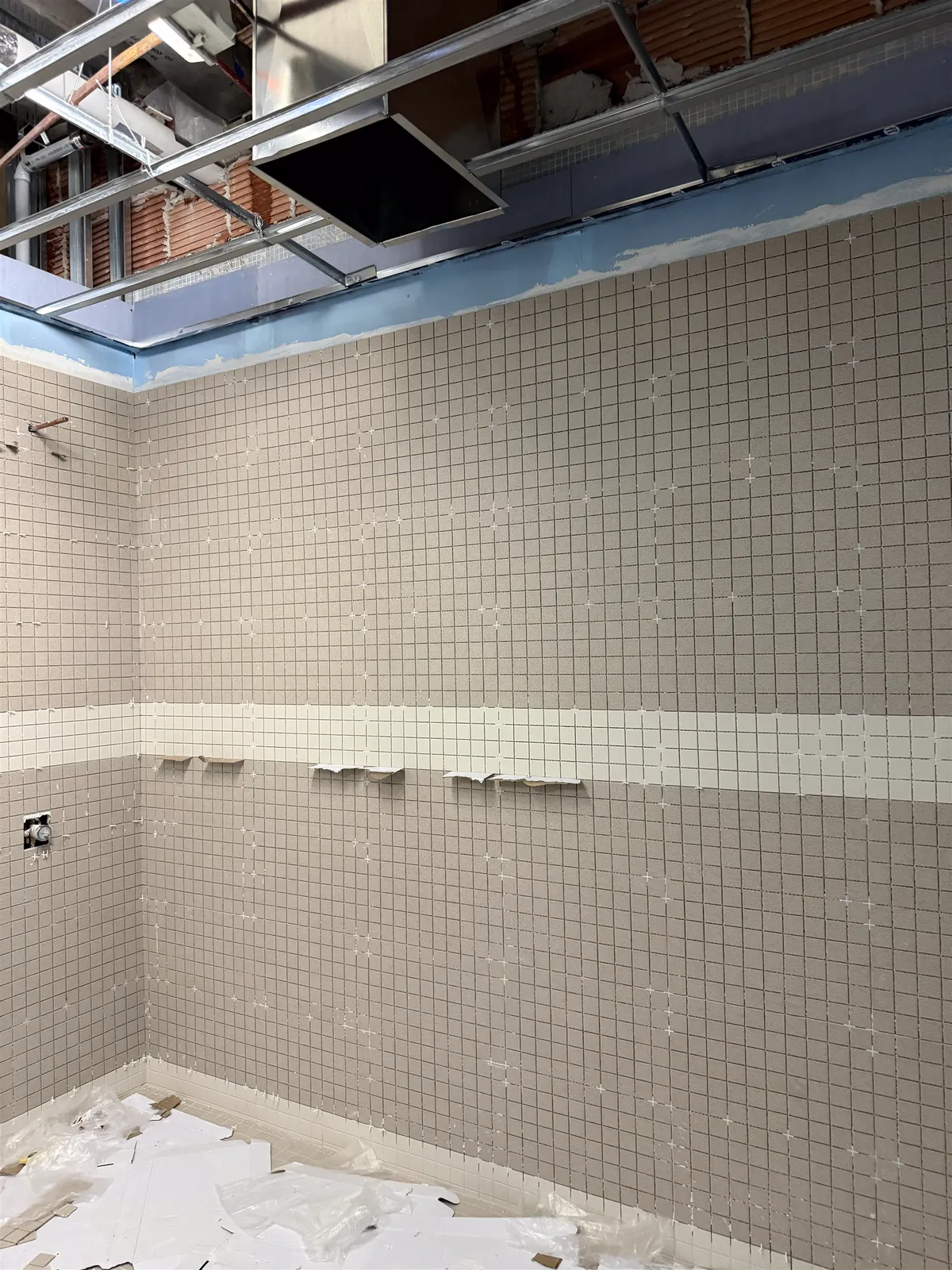
Most tiled pools use mosaic, and there are good reasons. Small pieces follow curves, coves, steps and the slope between shallow and deep ends without awkward cuts. A large tile can only sit flat; a sheet of mosaic bends with the surface.
The many grout joints also help. On pool floors, steps and ramps, they give bare feet grip. And because each piece is small, movement and stress are spread across many joints rather than concentrated in a few large tiles.
Pool mosaic is usually porcelain or glass, both with very low water absorption. Light colours are common in the basin because they make it easier to see the bottom, and swimmers on it, through the water. The lane lines and markings then stand out in a dark contrasting colour.
Not every mosaic can go under water. How the sheets are held together matters: some back-mounted sheets cover part of each piece with glue or mesh, and some tile, membrane and pool makers restrict certain backings in submerged areas. Our guide to mosaic tile installation explains sheet backings, layout and beating in. In a pool, check that both the mosaic maker and the setting-material maker approve the product for immersion.
Pool lane markings, T-markers and target crosses
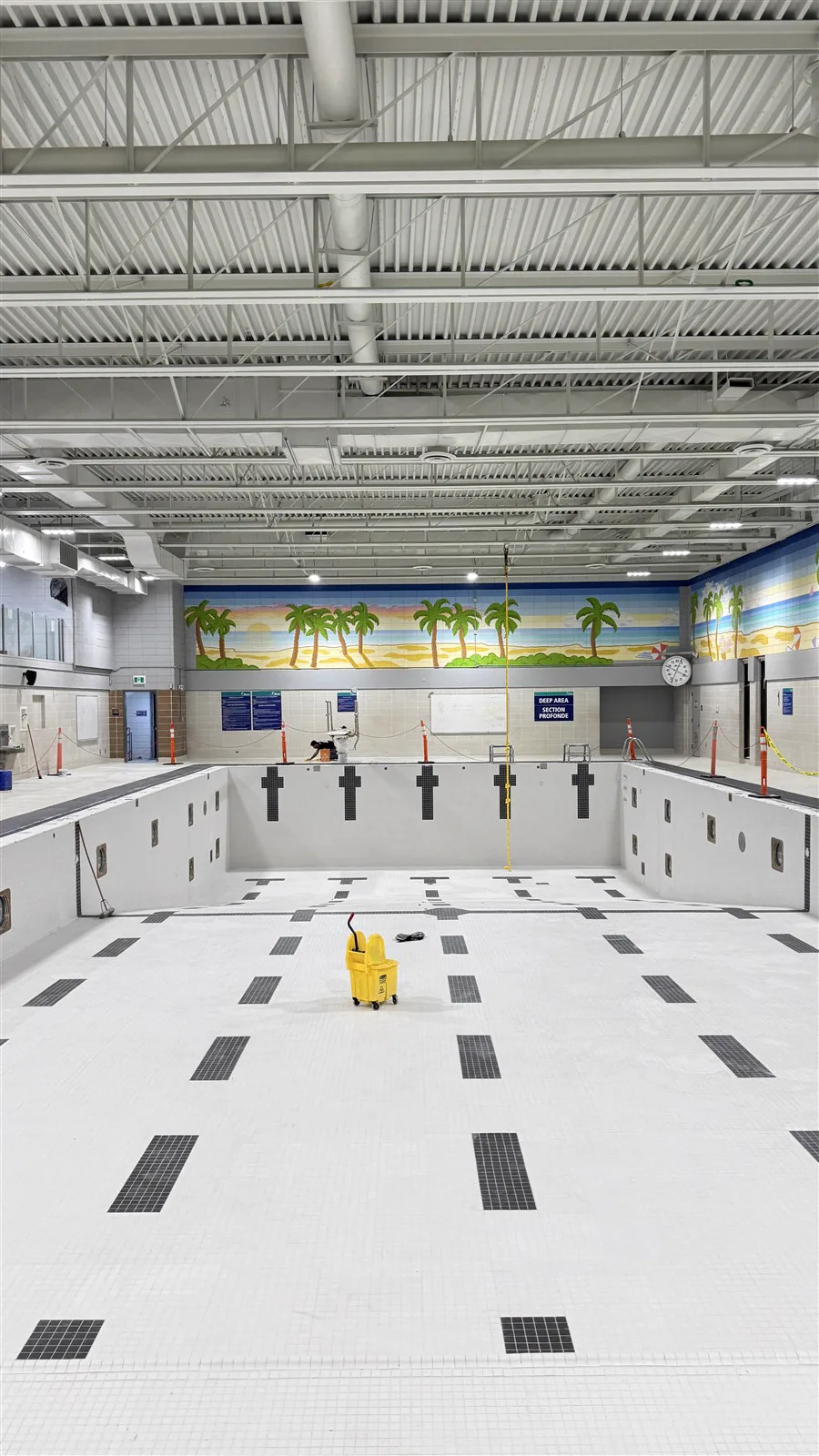
In a lap or competition pool, the markings are part of the tile. Each lane has a dark line down the centre of the floor that ends in a cross-bar, the T, before the wall, so a swimmer looking down knows the wall is coming. On the end walls, a target cross lines up with each lane. Depth markings are set on the deck and the pool walls so swimmers can see how deep the water is before they enter.
The sizes and positions of these markings follow the drawings, which are based on the rules for the type of pool and the sport it serves. Public pools in Ontario are also regulated provincially, and the design drawings show the markings the facility needs. The tile contractor's job is to set them exactly where the drawings say.
Setting them into the tile pattern has a big advantage: they never need repainting. It also means they must be laid out before a single sheet goes down. Lines are surveyed onto the finished mortar bed or membrane, and the mosaic sheets are planned so the dark pieces fall exactly on the lines. Sheets are cut and pieces swapped where a line or cross starts and stops. A lane line that drifts a little over the length of the pool is obvious from the deck, so the layout is checked as the work goes.
Pool deck tile
The deck takes a different kind of wear from the basin. It has bare feet, wet surfaces, cleaning machines, chemicals and sometimes heavy equipment rolling across it. Pool deck tile has to be slip-resistant when wet, easy to clean and tough enough for daily scrubbing.
Deck tiles are usually textured porcelain or mosaic, chosen to the specification's slip-resistance requirements. The deck slopes to drains so water doesn't sit, and the slope comes from the mortar bed, not from the tile. Where the deck meets the pool edge, the gutter or coping tile ties the two together, and that edge is often a contrasting colour so people can see it.
Depth markings and warning symbols on the deck are usually set in tile too, close to the edge where swimmers read them before entering. Movement joints in the deck tile, set where the drawings and industry guidance place them, let the large area move with temperature without cracking. See tile movement joints for why they matter on large floors.
Setting materials and grout for pool tile
A pool is a much harsher place for setting materials than a shower. The mortar has to bond under constant water, and the grout has to stand up to treated water and regular cleaning for a long time.
Mortar. Pool tile is set in high-performance mortars that the maker rates for submerged use and approves over its membrane. Coverage has to be essentially complete. Industry standards call for at least 95% mortar contact in wet areas, and in a pool any void behind a tile fills with water. Installers back-butter pieces where needed and lift sheets to check. Our guide to which thin-set to use explains the mortar categories.
Grout. Epoxy grout is often used in pools because it is dense, resists chemicals and stains, and doesn't need sealing. Some specifications call for a high-performance cement grout instead. Water chemistry matters here. Pool water that is out of balance can slowly attack cement-based grout and mortar, which is one reason epoxy is popular and why operators keep the water in range. Our comparison of epoxy grout vs cement grout covers the trade-offs. With either type, the specification and the maker's instructions decide.
One system. The membrane, mortar and grout are best chosen as one manufacturer's system, or a combination the makers approve together. That keeps the bond and any system warranty intact.
The fill: cure first, then water
The last step is the one owners are most eager for, and the one that can't be rushed. Water goes in only after the cure time the setting-material and grout makers require for submerged service. That cure is longer than for a dry floor, and it depends on the products and the temperature in the building.
Before the fill, the pool gets a final clean. Grout haze, mortar spots and construction dust come off the tile, because whatever is left on the surface will be much harder to remove under water. The deck, channels and fittings are checked, and any deficiencies are fixed while the basin is still dry.
Filling and start-up then follow the instructions of the pool contractor and the setting-material makers, including how fast to fill and when to bring the water up to temperature and chemistry. Rushing this stage can undo months of careful work.
Commercial pool tiling in practice: Canterbury Pool
Canterbury Pool in Ottawa is an institutional project for the City of Ottawa, and a good example of how these layers come together. Agora installed more than 10,000 sq ft of pool mosaic there. Mortar-bed channels were set along the deck. The waterproofing was applied across the basin and floated up to the walls before any tile went on.
The mosaic covers the basin, with the lanes, T-markers, target crosses and depth markings laid into the pattern, and the deck and gutter finished in tile. The pool was filled after a final clean. The Canterbury Pool project page shows each layer going in, from the mortar-bed channels to the first fill.
Projects like this are planned around the general contractor's schedule, with submittals and mock-ups where the specification asks for them. Our guide to commercial flooring explains how that process works on institutional jobs, and our page on commercial flooring in Ottawa lists the kinds of spaces we work on. General contractors can see how we price and work on our page for contractors and builders.
A note on residential pools
Many backyard pools around Ottawa are vinyl-liner or fibreglass, and tile, where it appears, is often a waterline band or a feature on steps. Fully tiled residential pools follow the same principles as commercial ones: a sound structure, a submerged-rated membrane, full mortar coverage and a proper cure before filling.
Outdoor pools add freeze-thaw. Any tile and setting material outside must be rated for frost, and the pool must be closed for winter as its builder recommends. Water left in a tile joint that freezes can pop tiles and crack grout. If you are planning tile on an outdoor pool, the pool builder's details come first.
Frequently asked questions
What kind of tile is used in commercial pools?
Mostly porcelain or glass mosaic in the basin, because small pieces follow curves and slopes and the joints give grip. The deck uses slip-resistant porcelain or mosaic chosen to the specification.
Does a tiled pool need waterproofing?
Yes. Concrete, tile and grout are not waterproof on their own. A membrane rated for submerged use goes over the whole basin and up the walls before the tile is set.
Are pool lane lines painted or tiled?
In a tiled pool they are usually set into the tile pattern, in a contrasting colour, so they never need repainting. Their positions and sizes come from the drawings.
What grout is used for pool tile?
Epoxy grout is often used for its chemical and stain resistance, and some specifications call for a high-performance cement grout. The specification and the maker's instructions for submerged use decide.
How long before a newly tiled pool can be filled?
Only after the cure time the mortar and grout makers require for submerged service. It is longer than for a dry floor and depends on the products and the temperature.
Why do pools use small mosaic tile instead of large tile?
Mosaics bend around curves, coves and slopes that large tile can't follow, and the many grout joints add grip for bare feet. They also spread movement across many joints.