
Short answer
Backsplash installation cost in Ottawa in 2026 starts at about $1,200 for a tiled kitchen backsplash, based on the average of published prices from Ottawa flooring companies. Per square foot, tile installation labour runs about $5 to $12, and supplied and installed, wall tile runs from about $9 to $20 for ceramic up to $25 to $50 for marble or glass. The tile, the pattern, the height and the number of outlets, windows and exposed edges make most of the difference.
A kitchen backsplash is one of the smallest tile jobs in a house, and one of the most visible. That makes its price behave differently from a floor. The cost to install a backsplash depends less on square footage and more on the details: the cuts around outlets and windows, how the edges are finished, and how much work the wall needs first. This guide explains what a backsplash costs, why, and how to read a quote.
All the figures here are already published on our site. The starting price comes from our Ottawa flooring cost guide: the average of the published 2026 price ranges of four Ottawa flooring companies, rounded, and where fewer than four published a price for an item, the range reflects the ones that did. The per-square-foot ranges come from our tile installation cost guide and our shower cost guide, which draw on that average and on 2026 Ottawa renovation price guides. They are a guide for budgeting, not an Agora Flooring price list. Your own price comes in a written quote after a free site visit.
Backsplash installation cost at a glance
| Item | Typical 2026 cost in Ottawa |
|---|---|
| Kitchen backsplash (whole job) | from about $1,200 |
| Tile installation labour (porcelain and ceramic) | $5 – $12 per sq ft |
| Ceramic tile, supplied and installed | $9 – $20 per sq ft |
| Porcelain tile, supplied and installed | $12 – $25 per sq ft |
| Mosaic tile, supplied and installed | $20 – $40 per sq ft |
| Marble or glass tile, supplied and installed | $25 – $50 per sq ft |
The labour figure applies when you have bought the tile yourself. The supplied-and-installed rows include the tile. The ceramic and porcelain ranges are the ones our shower cost guide uses for wall tile, which suits a backsplash better than a floor price, because walls are slower to tile than an open floor: every row is cut around something.
Why a backsplash is priced as a job, not just per square foot
A typical backsplash is small, often around 30 sq ft. At that size, the per-square-foot ranges alone give a low number. In practice, very small tile jobs are often priced as a whole, because the setup takes the same time whatever the size. The installer still protects the counter, prepares the wall, plans the layout, mixes mortar, cuts every outlet, finishes every edge, comes back to grout once the mortar has cured, and seals the joint at the countertop.
That is why the published figure is a starting price for the whole job, from about $1,200, rather than a rate per square foot. Use the per-square-foot ranges to see how much the tile choice moves the price. Use the whole-job figure as the more realistic starting budget for a kitchen backsplash.
How to measure your backsplash
Measure the length of every wall section that will be tiled, in feet, along the countertop. Multiply each one by the height of the tile. The gap between the counter and the upper cabinets is often about 18 inches, which is 1.5 ft. Add up the sections. Don't subtract outlets, and only subtract windows if they are large, because the cuts around them take time either way.
For example, an L-shaped kitchen with 20 ft of counter along the walls, tiled to the underside of the uppers at 18 inches, has 20 × 1.5 = 30 sq ft of backsplash. A full-height range wall 10 ft wide, tiled from the counter (commonly 36 inches high) to an 8 ft ceiling, is 10 × 5 = 50 sq ft, because 96 − 36 = 60 inches, or 5 ft. Order extra tile for cuts and keep a few spare pieces for future repairs. Patterns such as herringbone need more extra than a straight layout.
Example backsplash costs
These examples multiply the published per-square-foot ranges by the two areas measured above. They show how the tile choice moves the price. They do not include removing an old backsplash, wall repair or electrical work.
| Tile, supplied and installed | 30 sq ft (to the uppers) | 50 sq ft (full-height wall) |
|---|---|---|
| Ceramic, $9 – $20 | $270 – $600 | $450 – $1,000 |
| Porcelain, $12 – $25 | $360 – $750 | $600 – $1,250 |
| Mosaic, $20 – $40 | $600 – $1,200 | $1,000 – $2,000 |
| Marble or glass, $25 – $50 | $750 – $1,500 | $1,250 – $2,500 |
The math for the 30 sq ft backsplash: ceramic is 30 × $9 = $270 to 30 × $20 = $600. Porcelain is 30 × $12 = $360 to 30 × $25 = $750. Mosaic is 30 × $20 = $600 to 30 × $40 = $1,200. Marble or glass is 30 × $25 = $750 to 30 × $50 = $1,500. If you supply the tile, labour alone is 30 × $5 = $150 to 30 × $12 = $360. For the 50 sq ft wall, multiply by 50 instead: ceramic is 50 × $9 = $450 to 50 × $20 = $1,000, and marble or glass is 50 × $25 = $1,250 to 50 × $50 = $2,500.
Most of these per-square-foot results are below the published starting price of about $1,200. That is the job-size effect described above, not a discount. For a standard kitchen, budget from the whole-job figure, then expect it to rise with premium tile, a pattern, full height or many cuts.
Tile type and pattern
The tile is the first thing that moves a backsplash price. Ceramic subway tile is the most affordable, cuts easily and comes with matching trim pieces in many lines. Porcelain is harder and slower to cut. Mosaics cover less area per piece and need care at the joints between sheets, so they cost more to install as well as to buy; see mosaic tile installation.
Glass and marble sit at the top of the published ranges. Glass needs a white mortar made for it, because grey mortar and trowel ridges show through. Marble and other natural stone are softer, need sealing, and need a grout that won't scratch a polished face. Large porcelain panels need a mortar made for large and heavy tile and full coverage on the back, and often two people to set them.
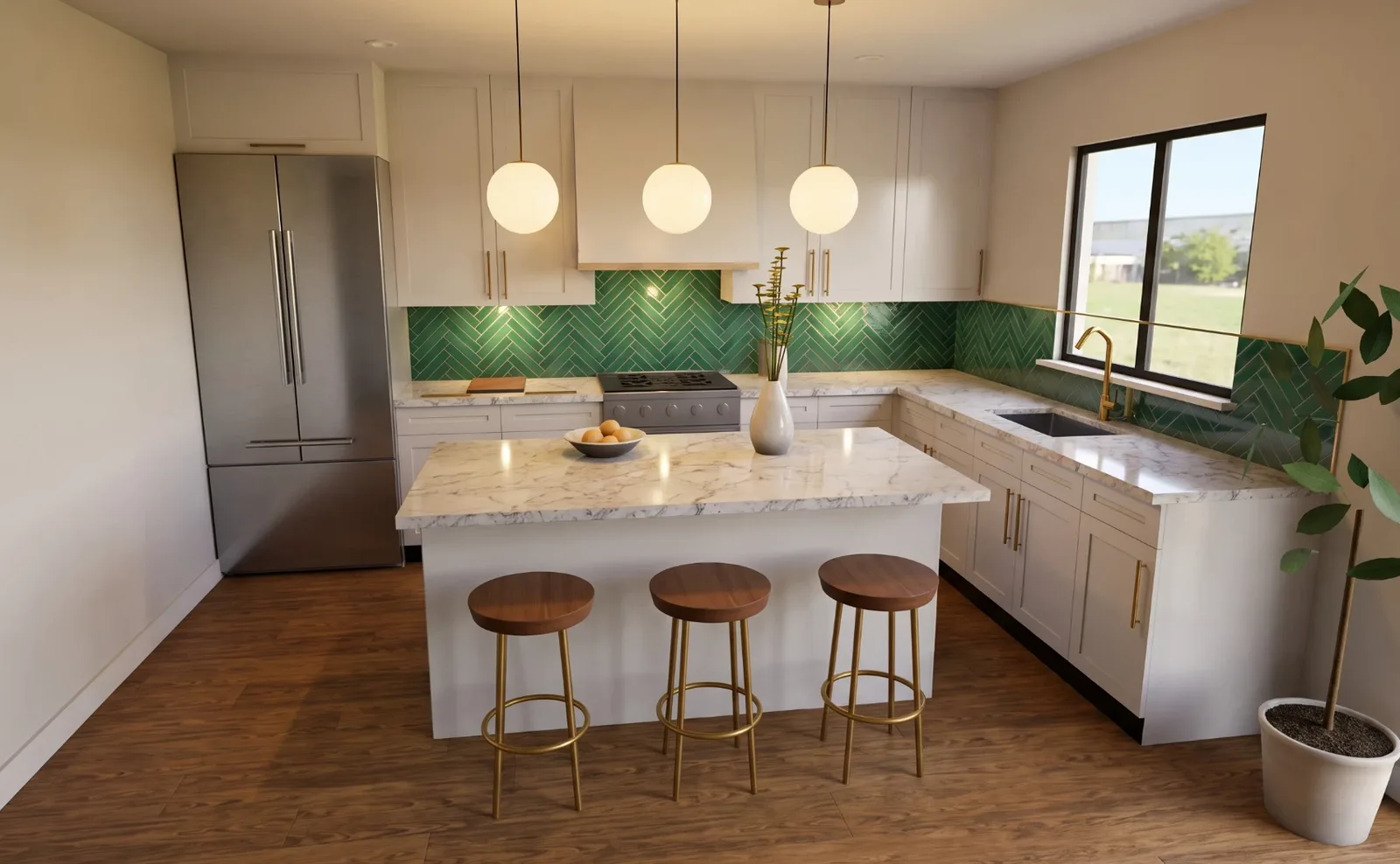
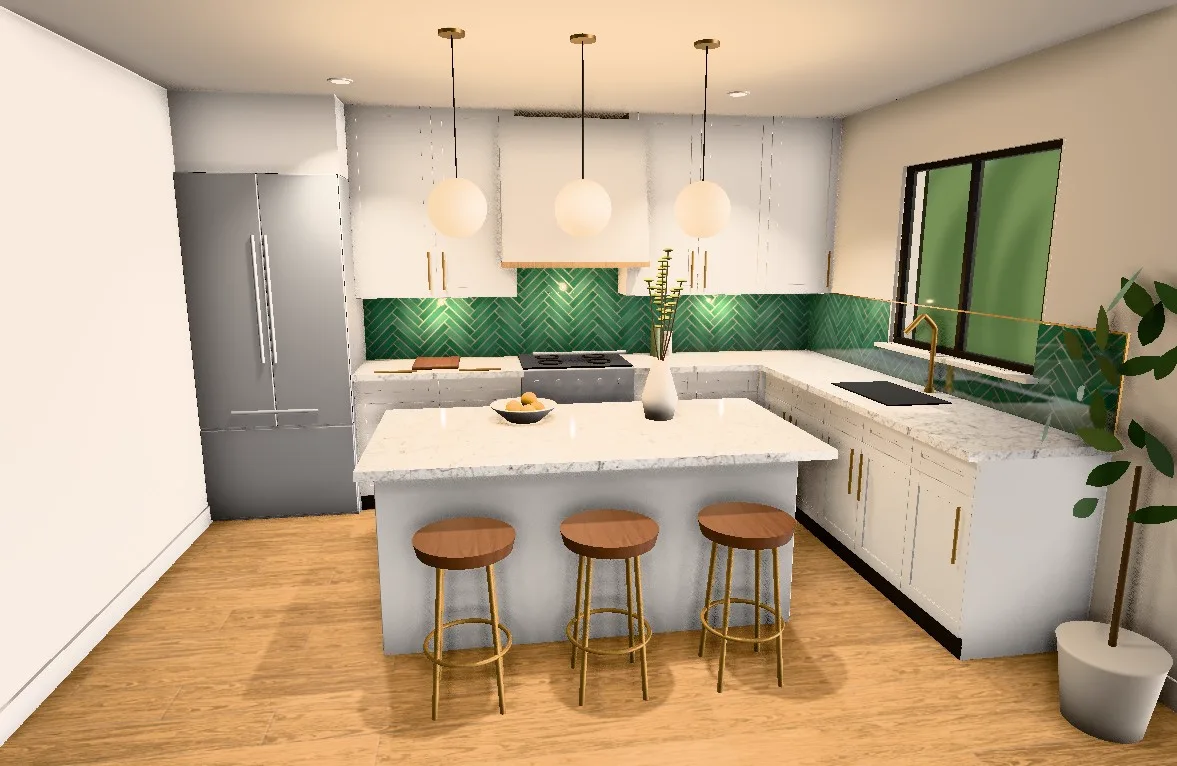
The layout matters as much as the tile. A straight or brick layout is the quickest. Herringbone, chevron and other patterns need many more cuts and more extra tile, and the layout has to be centred so the pattern meets the range hood and window symmetrically. For styles and what each one involves, see our kitchen backsplash ideas.
Height, outlets and window returns
Where the backsplash stops changes the price. Stopping at the underside of the upper cabinets is the most common choice, and the height is fixed and easy to plan. A full-height backsplash, to the ceiling or up to a range hood, uses more tile and makes the top cut and the layout around windows more visible.
Outlets and switches are where most of the backsplash cuts happen. Each one is marked, notched or cut out so the cover plate hides the edge. Tile adds thickness to the wall, so the boxes often need extenders to bring the outlets out flush with the new surface. More outlets mean more cuts and more time.
Windows add time too. The tile can stop at the window trim, or wrap into the window return, which needs finished edges and careful cuts measured piece by piece, because window openings are rarely square. A kitchen with a window over the sink and a dozen outlets takes noticeably longer than a plain wall of the same size. Our guide to backsplash installation walks through each of these steps.
Edges: trim, bullnose or mitres
Wherever a backsplash ends in mid-air, at the end of a counter, beside a window or at the top of a partial-height backsplash, the edge of the tile shows. The cut edge of glazed tile shows the clay body and chips easily, so it has to be finished.
There are three common ways, and each has a different cost. A metal or PVC edge profile is set into the mortar as the end tiles go on; it adds material and some labour. Many ceramic wall tile lines include bullnose or pencil trim pieces, which are bought with the tile. With colour-body or through-body porcelain, the edges can be mitred, which takes the most time and skill. Choose the method before tiling, because a profile goes in with the tile. Our guide to tile edge trim vs mitred edges compares them.
Removing an old backsplash and repairing the wall
A kitchen backsplash is a dry area, so sound, flat drywall is a good base; our guide on tiling over drywall explains why. If the wall already has tile, removing it usually damages the drywall behind it, and the wall is patched or the damaged section replaced before the new tile goes on. Uneven drywall is filled or skimmed so the new tile sits flat. There is no published average for this on our site, because the work depends on what comes off and what is underneath. It is usually priced once the wall can be seen.
Sometimes an old tile backsplash can be tiled over, if it is solid and flat; see can you tile over tile. That saves the removal and repair, but it adds thickness at the outlets and edges, so it needs to be planned.
What's usually not included in a backsplash quote
A backsplash quote covers the tile work. These items are often outside it, so ask who takes care of each:
- Moving, adding or rewiring outlets and switches, which is done by a licensed electrician, with an ESA permit where required.
- Removing an old backsplash and repairing or replacing the drywall.
- Installing the countertop, which goes in before the backsplash.
- Removing and reinstalling the range, range hood or under-cabinet lights.
- Painting the wall above or beside the tile.
Ask your contractor whether box extenders, edge trim, sealant at the countertop and a stain-resistant grout are included. Agora tiles the backsplash; it does not do the electrical work.
How to compare backsplash quotes
Check that each quote covers the same walls, the same height and the same tile, including any full-height section behind the range. Ask how the edges will be finished, and with what. Confirm the grout, because a backsplash collects grease and food, and epoxy or high-performance grout resists staining best; see epoxy vs cement grout. Look for wall preparation and removal of the old backsplash, if there is one, and whether HST is included.
A detailed quote is easier to compare than a single number. Agora gives free estimates in person, by phone, by email or online, and a written quote. We installed the food-station backsplashes at Teraanga Commons at Carleton University; see our kitchen backsplash installation page for how we work.
Frequently asked questions
How much does it cost to install a kitchen backsplash?
In Ottawa, a tiled kitchen backsplash typically starts at about $1,200, based on the average of published 2026 prices. The tile, the pattern, the height and the number of outlets, windows and edges move it up from there.
What is the backsplash installation cost per square foot?
Tile installation labour runs about $5 to $12 per sq ft. Supplied and installed, wall tile runs about $9 to $20 for ceramic, $12 to $25 for porcelain, $20 to $40 for mosaic and $25 to $50 for marble or glass. Small jobs are often priced as a whole rather than per square foot.
How many square feet is a typical kitchen backsplash?
Multiply the length of the tiled walls by the height. A backsplash 20 ft long and 18 inches high is 20 × 1.5 = 30 sq ft. Full-height walls add much more.
Is a full-height backsplash much more expensive?
It uses more tile and has more cuts at the top and around windows, so it costs more. Many kitchens tile only the range wall to full height as a feature.
Does backsplash installation include moving outlets?
No. Moving or adding outlets is work for a licensed electrician. Existing outlets usually stay where they are, with box extenders so the plates sit flush on the new tile.
Is removing the old backsplash included?
Often not. Removing old tile usually damages the drywall, which then needs repair, and that is priced once the wall can be seen.